
Planet Ganges helps enterprises evaluate how work actually happens, redesign business processes for maximum efficiency and impact, and only then digitise them using AI-enabled tools, intelligent automation and integrated enterprise systems.
Most organisations start with the platform. We start with the work. That difference determines whether digital transformation removes friction, or simply digitises it. It is the principle behind every digital transformation consulting engagement we run.
A process may be slow because it contains too many approvals. It may be expensive because work is duplicated across teams. It may depend on spreadsheets, manual hand-offs or the judgment of a few individuals. It may generate data without producing decisions.
Digitising that process does not automatically improve it. It can make the same dysfunction move faster, spread further and become more difficult to unwind. Where the mandate is enterprise-wide rather than process-level, that work sits within our business transformation consulting practice.
Planet Ganges begins with process truth: how value actually moves through the organisation, where it stalls, why exceptions occur, who owns the decisions, where data breaks and which activities no longer add value. Only after that truth is established do we determine what should be eliminated, simplified, standardised, automated or enabled through AI.
Automation multiplies the logic already embedded in a workflow. When that logic contains unnecessary steps, duplicated controls or unclear ownership, automation makes the problem faster rather than better.
A platform is selected before the future-state process is defined. The implementation then becomes an exercise in configuring software rather than redesigning how the business should operate.
Individual functions digitise their own activities while the end-to-end customer or business journey remains fragmented. Departmental efficiency improves, but enterprise cycle time does not.
Employees are trained on a new system, but roles, decision rights, performance measures and leadership expectations remain unchanged. The new platform arrives; the old behaviour survives.
Digital transformation is not the installation of technology. It is the redesign of the business, enabled by technology.
Sustainable digital transformation requires more than a new platform. Strategy, customer value, process design, technology, people, data and execution must work as one integrated system.
The Planet Ganges Digital Transformation Framework brings these dimensions together so that transformation creates measurable value without weakening control, accountability or organisational resilience.
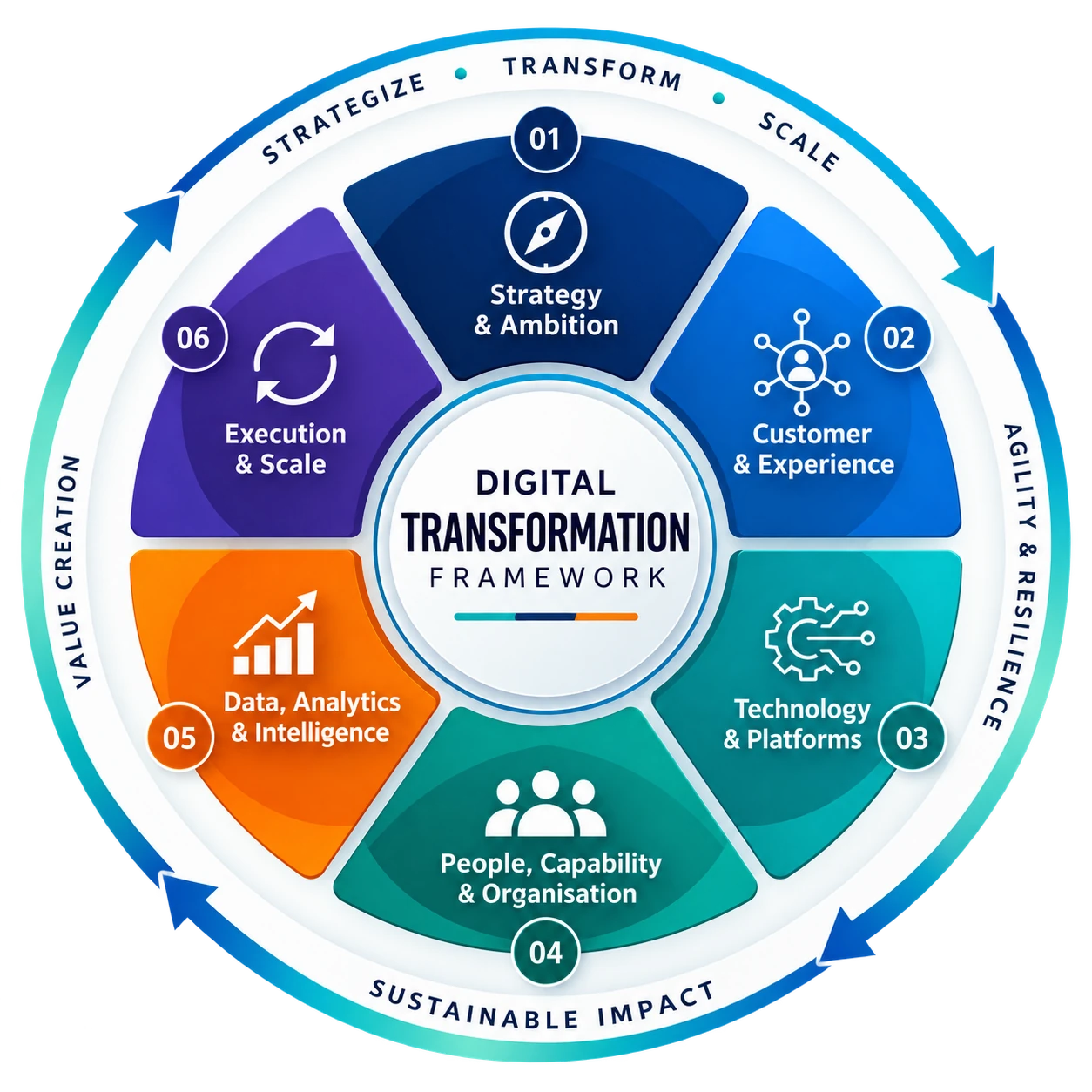
Define the business outcomes transformation must deliver. This includes enterprise priorities, executive ownership, investment logic, transformation boundaries and the measures that will determine whether the effort has created value, aligned to the wider business strategy consulting agenda.
Redesign around the customer and the outcome, not around departmental convenience. Customer journeys, employee journeys and stakeholder moments of truth reveal where internal friction becomes external dissatisfaction.
Choose technology after the future-state process is clear. The right architecture may combine existing enterprise systems, workflow platforms, intelligent automation, AI tools, data infrastructure and targeted custom solutions.
Redesign how people operate within the new system. Roles, capabilities, decision rights, performance expectations and leadership behaviour must evolve alongside the process. Adoption is an operating-model issue before it is a training issue, and it frequently runs alongside leadership development consulting.
Turn operational data into trusted decisions. Data must be captured at the right points, governed consistently and made available to the people, analytics engines and AI systems that require it.
Move from a successful intervention to an enterprise capability. Digital solutions must be piloted, integrated, governed, measured and extended without creating new fragmentation or uncontrolled risk.
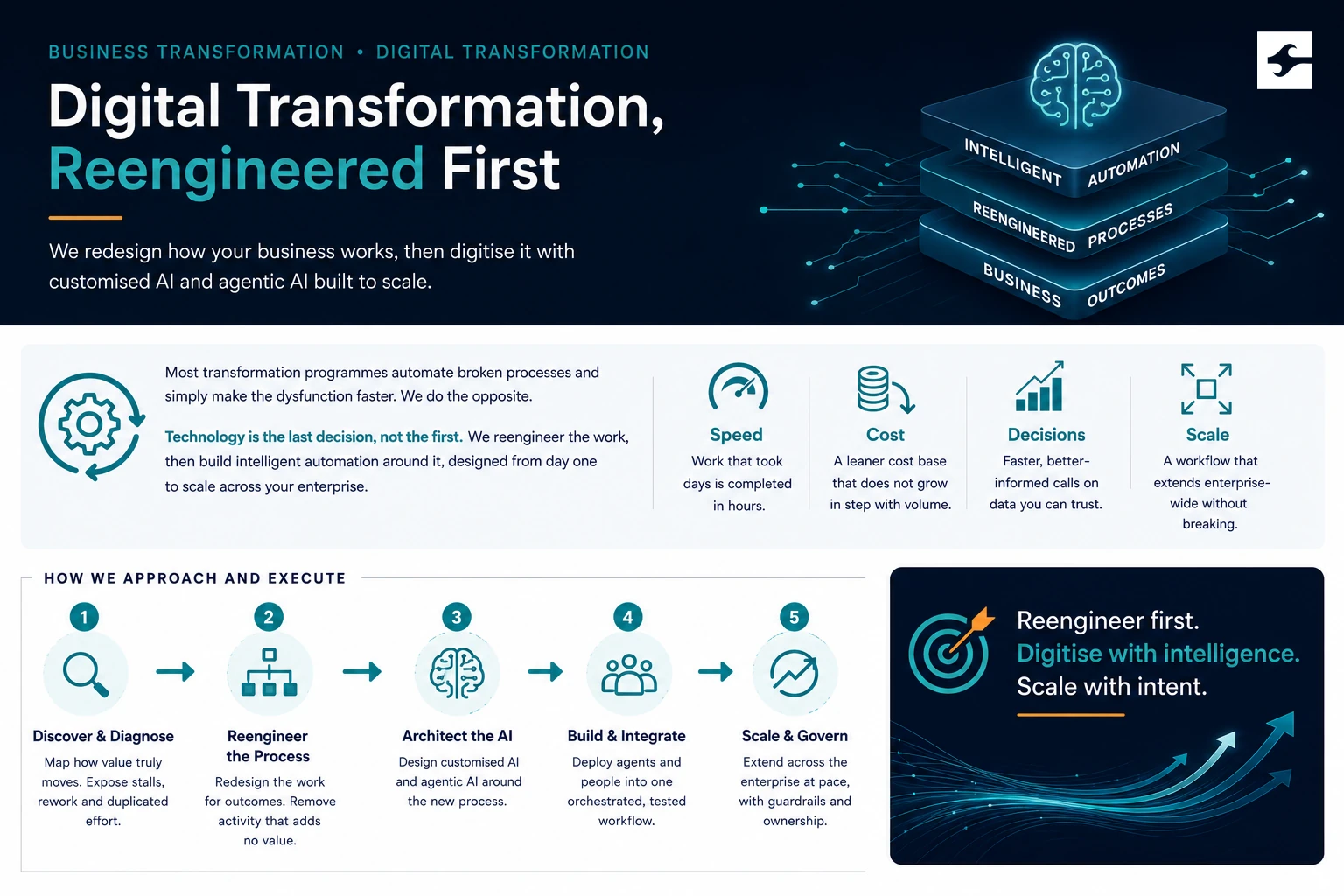
We map how work actually moves through the business, not merely how the documented process says it should move.
The diagnostic examines value flow, activities, hand-offs, waiting time, rework, exceptions, controls, decision points, system dependencies and data gaps. Existing performance measures are reviewed and a current-state baseline is established wherever reliable data is available.
Every process step is challenged. What can be eliminated? What should be simplified? What can be standardised? Where should authority sit? Which controls genuinely manage risk, and which merely add delay? Which exceptions should remain human decisions?
The future-state process is designed around business outcomes rather than inherited habits.
The redesigned process is translated into digital requirements.
We identify where workflow automation, AI, analytics, data integration, enterprise platforms or human judgment should sit. Technology options are evaluated against process fit, scalability, security, governance, user experience and value.
The solution is implemented in controlled increments with defined ownership, test scenarios, exception handling, controls and measurable outcomes.
Planet Ganges works with internal technology teams and specialist implementation partners where required, while maintaining alignment between the business design and the digital solution.
The new process is extended across teams, locations or business units through a disciplined scale-up model.
Performance is tracked against the original baseline. Adoption gaps, benefit leakage, control risks and new bottlenecks are identified and corrected as the business evolves.
Depending on the scope, a digital transformation consulting engagement may produce:
A structured assessment of process maturity, friction, ownership, technology dependence and transformation readiness.
A clear picture of activities, decisions, hand-offs, delays, data movement, exceptions and control points.
Identification of duplicated activity, unnecessary approvals, avoidable rework, unclear ownership and non-value-adding effort.
A redesigned process with simplified flow, defined ownership, decision rights, controls and performance measures.
A prioritised view of where automation, generative AI, AI agents, analytics or decision support can produce meaningful value.
A practical comparison of value, cost, complexity, risk, readiness and implementation effort.
The systems, data, integrations, automation components, governance controls and human interventions required by the future-state process.
A sequenced implementation plan covering pilots, dependencies, ownership, investment decisions and scale-up.
The roles, skills, communication, leadership behaviour and performance reinforcement needed to sustain the new way of working.
A defined baseline and scorecard for monitoring cycle time, cost, productivity, service, decision quality, adoption and business impact.
Shorter cycle times, faster decisions and fewer avoidable hand-offs.
Reduced rework, duplication, manual effort and process complexity.
More reliable information, clearer exceptions and better-informed action.
Simpler journeys, more predictable service and quicker resolution.
Clear accountability, stronger auditability and more consistent governance.
The ability to handle greater business volume without a proportional increase in headcount, approvals and coordination effort.
The first question should not be, “Where can we use AI?” The first question should be, “Which business outcome are we trying to improve, and what prevents the current process from delivering it?”
Once the process has been simplified and the decision requirements are understood, AI can extend capability in ways that conventional workflow automation cannot. Depending on the business need, the digital solution may include:
Where the requirement is an enterprise-wide AI strategy, operating model and governance framework rather than a process redesign, that work sits within our AI-led digital transformation advisory.
The test is not whether AI can be inserted into a process. The test is whether it improves a defined business outcome, works with reliable data, operates within appropriate controls and remains accountable to a clearly identified business owner.
These are the process families where redesign before digitisation produces the largest measurable gain. Our transformation case studies show how this has played out across industries.
Lead management, opportunity qualification, proposal development, pricing, approvals and sales conversion.
Order capture, fulfilment, invoicing, collections, credit management and customer communication.
Demand planning, vendor selection, purchase approvals, receipt, invoice matching and payment.
Production planning, material availability, scheduling, quality, maintenance and operational visibility.
Customer requests, complaints, claims, case management, field service and escalation.
Financial close, reconciliations, management reporting, performance analysis and compliance.
Recruitment, onboarding, employee services, performance, development, mobility and separation.
Business reviews, forecasting, scenario planning, enterprise dashboards, exception management and executive decisions.
A process-led digital transformation engagement is especially relevant when:
We begin with the business problem and the process that produces it. Technology selection follows business design rather than driving it.
We examine the entire value flow across functions, decision levels, data sources and organisational boundaries, not an isolated activity in one department.
Tools and platforms are evaluated according to process fit, business value, integration, governance and scalability rather than vendor preference.
Transformation requires more than a technically correct solution. Executive ownership, decision rights, capability, accountability and performance reinforcement are designed into the engagement.
The same transformation logic carries from current-state assessment through process redesign, digital architecture, implementation governance and benefits realisation.
Planet Ganges helps leadership distinguish between what should be eliminated, what should remain human, what can be automated and where AI can create genuine advantage.
Rate each statement from 1 (strongly disagree) to 5 (strongly agree). Nothing is submitted or stored. The score is yours alone.
Nothing is submitted or stored. The score is yours alone.
Planet Ganges works at the intersection of business transformation, leadership alignment, process architecture and digital enablement. Our digital transformation consulting engagements begin with the business, not the platform. Our role is to help boards, CEOs, CXOs and transformation leaders ensure that digital investment improves how the enterprise operates, not merely the technology it owns.
Founder & CEO, Planet Ganges
With more than 34 years of experience working with founders, leadership teams and organisations across industries and geographies, Anand brings a business-first lens to enterprise transformation, organisational design, leadership capability and execution.
The objective is not to make a process look digital. It is to make the business work better, and then give that better design the technology required to scale.
Digital transformation rarely arrives alone. It sits alongside the transformation architecture, the enterprise design and the leadership capability that determine whether the change holds.
Leadership Accelerated Capability Enhancement. Transformation architecture for established enterprises across direction, structure and execution.
Nine pillars of enterprise design for founder-led companies moving from founder dependency to institutional resilience.
The nine capability shifts that turn reliable senior leaders into enterprise-ready ones, and build leadership density.
Six dimensions of process-led digitisation. Reengineer the work, then give it the technology and intelligence required to scale.
Choose a high-value, high-friction business process. Planet Ganges will help you establish the current-state truth, identify where value is being lost and determine whether the right answer is simplification, process redesign, automation, AI, or a carefully governed combination of them.
Planet Ganges works with enterprises across India, the Gulf and international markets, with digital transformation consulting teams based in Bangalore and Dubai. All enquiries and transformation discussions are treated as confidential.
Process-led digital transformation begins by examining and redesigning how the business operates before selecting or implementing technology. It connects business outcomes, customer journeys, process flow, decision rights, data, people and digital systems so that technology enables a better operating model.
Process automation uses technology to perform specific activities with less manual effort. Digital transformation is broader. It may eliminate activities, redesign the process, change roles and decisions, improve data flow, introduce automation or AI, and create a new operating model across functions.
Automation can form part of digital transformation, but automation by itself is not transformation.
Automation reproduces the logic embedded in a process. When the process contains unnecessary approvals, duplicated effort, unclear ownership or poor controls, automation can institutionalise those weaknesses.
Optimisation removes avoidable complexity so that technology is applied only to work that should continue to exist.
AI-enabled business process automation combines workflow technology with capabilities such as generative AI, machine learning, document intelligence, predictive analytics and AI agents.
It is especially valuable where processes involve unstructured information, judgment, exceptions, recommendations or interaction across several systems.
Planet Ganges follows a technology-agnostic approach. We define the business and process requirements first, assess relevant technology options and help leadership evaluate them according to business value, process fit, integration, governance, scalability and total cost.
Implementation may involve the organisation's internal technology team or specialist technology partners, depending on the agreed scope.
Yes. Digital transformation does not always require system replacement.
The engagement may identify opportunities to improve configuration, simplify workflows, connect existing systems, add an automation layer, improve data architecture or introduce targeted AI capabilities. Replacement is considered only when the existing environment cannot support the future-state process.
Agentic AI can support processes in which software agents interpret information, take permitted actions, coordinate tasks and escalate exceptions.
It should be introduced only where the process, authority boundaries, data access, risk controls, human oversight and performance measures are clearly defined.
Measures are established against the current-state baseline and may include:
The measure depends on the business outcome the process is designed to improve.
Duration depends on the complexity of the process, number of functions involved, data and system readiness, implementation requirements and scale of rollout.
A focused diagnostic may be completed relatively quickly. Enterprise process redesign and implementation are normally sequenced into clearly defined phases with measurable outputs at each stage.
The sponsor should be the executive who owns the business outcome.
Depending on the process, this may be the CEO, COO, CFO, CHRO, Chief Digital Officer, CIO or a functional business leader. Technology leadership remains essential, but ownership of value and adoption should remain with the business.