Leadership Inflexion · C-Suite Readiness · Leadership Continuity

There is a point where more effort stops producing more leadership.

Leadership Inflexion is the Planet Ganges advisory practice for CXO and C-suite readiness. It works with executives already in seat, successors being readied for the top table, CXOs inside their first 180 days, and leadership teams that need to operate as a unit.

The work combines leadership team diagnostics, CXO transition coaching, succession readiness and bespoke organisational interventions to turn reliable senior leaders into enterprise-ready ones, and to build the leadership density, bench strength and continuity an enterprise needs to keep promoting from within.

CXO, C-suiteAnd C-suite minus one
NineEnterprise-readiness capabilities
DiagnosisBefore design
IndividualAnd team engagements
What the inflexion is

Where effort has to give way to leverage.

Senior careers are built on personal delivery. Work harder, know more, be the one who can be relied on. That curve rises steadily, and then it bends. Somewhere around the top of a function, personal effort stops converting into enterprise impact, and the leaders who keep pushing the old lever find themselves working harder for a flatter return.

The inflexion is the point where the source of impact changes. Beyond it, leadership is exercised through direction, influence and the capability of others rather than through personal output. Very few organisations name this transition, and almost none develop for it deliberately.

The leadership inflexion point Two curves plotted against seniority and enterprise impact. The personal effort curve rises then flattens. At the inflexion point a second curve, driven by leverage and direction, continues to rise steeply. Effort Leverage Impact scales with personal effort Impact scales with leverage, direction and other people THE INFLEXION POINT Seniority and scope of mandate Enterprise impact

Careers stall at the bend, not at the bottom. So does succession.

Where this sits

Two ways into Inflexion, depending on who needs to move

This page covers the advisory practice: one to one work with CXOs and C-suite successors, leadership team diagnostics, transition coaching and succession readiness, designed to a specific organisational gap.

Where the need is a structured cohort journey for high-potential and newly-elevated leaders, that runs as the Inflexion leadership acceleration programme, which takes a group of leaders through the step-up together.

Why capable senior leaders stall

Why CXOs and C-suite successors stall, and it is rarely about capability.

These are strong performers. They were promoted because they delivered. What holds them at the threshold is a set of behaviours that worked beautifully one level down and quietly work against them at the top table.

Stall pattern 01

The Expert Trap

Promoted for depth, now required to show breadth. The leader keeps returning to the specialism where they feel authoritative, and the enterprise conversation happens without them. Letting go of the work that built the reputation feels like losing the reputation.

Stall pattern 02

The Reliability Ceiling

Trusted to deliver, not yet trusted to decide. Quiet competence earns respect but not sponsorship. The leader is in every important room and shaping none of them, and is repeatedly described as ready in a year or two.

Stall pattern 03

Diplomacy That Became Avoidance

Friction gets smoothed rather than held. Hard feedback is softened until it carries no signal, and the undiscussable stays undiscussed. The team reads the avoidance accurately and calibrates its own candour to match.

Stall pattern 04

Waiting for Certainty

At senior altitude the data is never complete, and the cost of waiting exceeds the cost of being partly wrong. Leaders trained to be right struggle to commit directionally, and the organisation stalls behind an unmade decision.

The cost of the gap

The same gap looks entirely different from the two sides of the table.

Leaders experience the inflexion as a personal frustration. Organisations experience it as a structural risk. Both descriptions are of the same underlying capability gap, which is why individual coaching and organisational readiness belong in one practice rather than two.

The leader experiences it as
The enterprise pays for it as
Working harder each year for a flatter return
Leadership density that lags revenue and complexity
Being valued for delivery but passed over for the mandate
A succession plan that is a list of names, not a state of readiness
Feedback that says not quite ready without saying what for
Critical roles with one credible successor, or none
A calendar full of execution and empty of direction
External CXO hires made because the bench was not ready
Watching peers with less depth move further
Transitions that take twelve to eighteen months to reach traction
Uncertainty about what the next level actually requires
Culture change announced repeatedly and embedded rarely
The nine capabilities

What actually has to change.

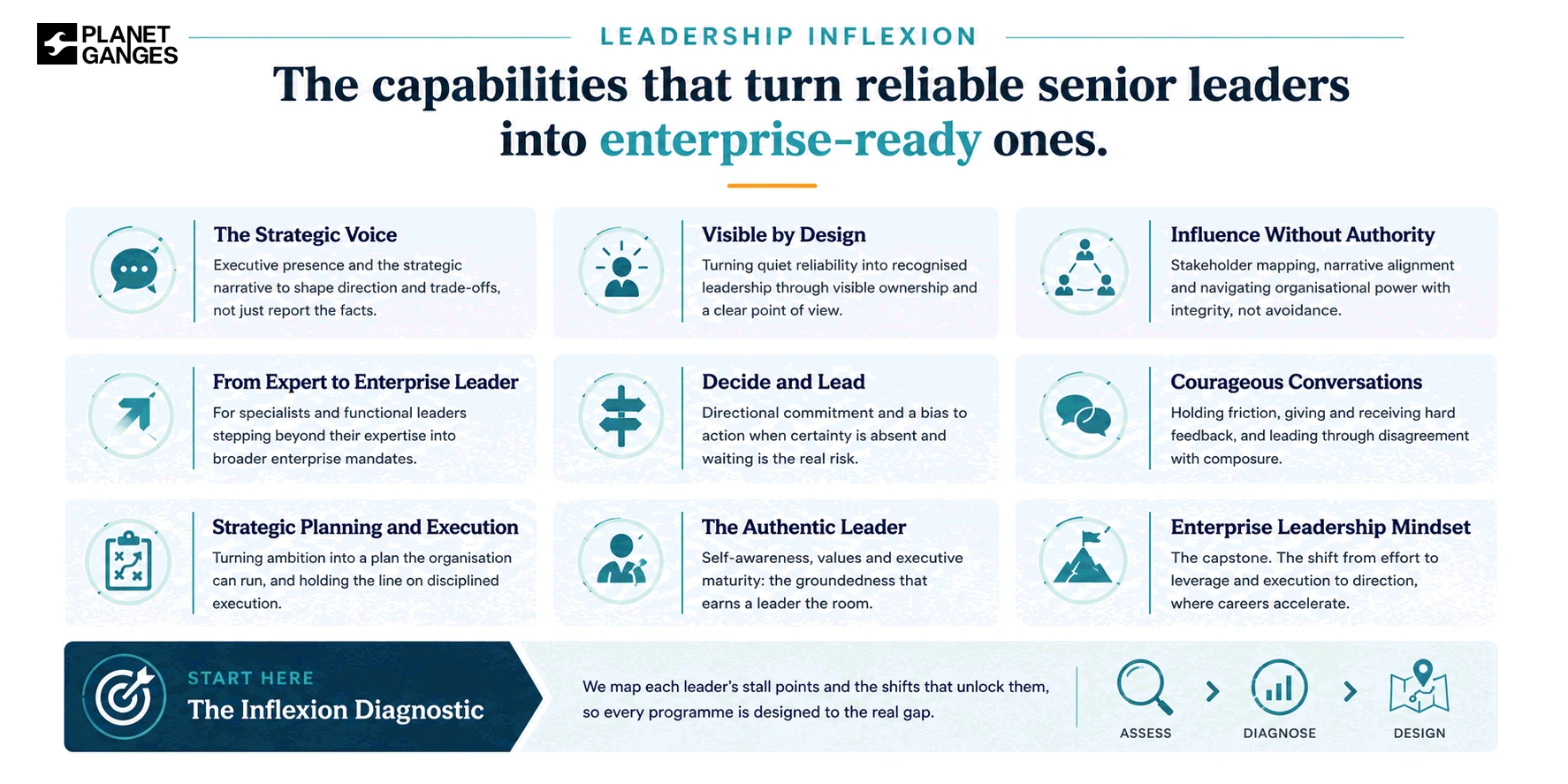
Nine capabilities separate a reliable senior leader from an enterprise-ready one. The first eight are the mechanics of getting through the bend. The ninth is the mindset shift that the other eight add up to, and it is where careers and organisations accelerate together.

The Leadership Inflexion framework showing nine capabilities that turn reliable senior leaders into enterprise-ready ones, with the Inflexion Diagnostic sequence of assess, diagnose and design.
The Leadership Inflexion capability set, with the diagnostic that precedes any programme design.
1

The Strategic Voice

Present in the room, but reporting rather than shaping it.

Executive presence and the strategic narrative to shape direction and trade-offs, not just report the facts. Building a point of view that holds up under challenge from peers, the CEO and the board.

  • Executive presence
  • Strategic narrative
  • Board communication
  • Point of view
2

Visible by Design

Reliable, respected, and repeatedly overlooked.

Turning quiet reliability into recognised leadership through visible ownership and a clear point of view. Reputation stops being a by-product of good work and becomes something built deliberately.

  • Visible ownership
  • Sponsorship
  • Executive exposure
  • Reputation by design
3

Influence Without Authority

Influence stops at the boundary of the function.

Stakeholder mapping, narrative alignment and navigating organisational power with integrity, not avoidance. Building coalitions across peers who do not report to you and do not have to agree with you.

  • Stakeholder mapping
  • Coalition building
  • Power navigation
  • Narrative alignment
4

From Expert to Enterprise Leader

Promoted for depth, now needing breadth.

For specialists and functional leaders stepping beyond their expertise into broader enterprise mandates. Commercial fluency, enterprise trade-offs, and the discipline of leading work you are no longer the best at.

  • Function to enterprise
  • Commercial fluency
  • Enterprise trade-offs
  • Letting go
5

Decide and Lead

Waiting for a certainty that is not coming.

Directional commitment and a bias to action when certainty is absent and waiting is the real risk. Deciding at the right altitude, at the right moment, and carrying the organisation through the decision rather than around it.

  • Decision quality
  • Bias to action
  • Decision altitude
  • Ambiguity tolerance
6

Courageous Conversations

Politeness doing the work that candour should.

Holding friction, giving and receiving hard feedback, and leading through disagreement with composure. Naming what the room already knows but will not say, without damaging the relationship or the person.

  • Hard feedback
  • Conflict capability
  • Naming the undiscussable
  • Composure
7

Strategic Planning and Execution

Ambition that never becomes a plan the organisation can run.

Turning ambition into a plan the organisation can run, and holding the line on disciplined execution. Sequencing, owned outcomes and a cadence that survives contact with the first surprise.

  • Strategy cascade
  • Sequencing
  • Execution discipline
  • Operating cadence
8

The Authentic Leader

Performing a version of leadership rather than leading.

Self-awareness, values and executive maturity: the groundedness that earns a leader the room. What holds steady under pressure, scrutiny and scale, when the borrowed style stops working.

  • Self-awareness
  • Values clarity
  • Executive maturity
  • Resilience
9

Enterprise Leadership Mindset

Still measuring themselves by personal output.

The capstone. The shift from effort to leverage and execution to direction, where careers accelerate. This is the inflexion itself, and the other eight capabilities are how a leader gets through it.

  • Effort to leverage
  • Execution to direction
  • Enterprise ownership
  • Acceleration
Designed to the real gap

Four leadership situations, four different interventions.

CXO, C-suite and the layer below are not one audience. They stall differently, they are assessed differently, and they need different interventions. Select the situation that matches yours.

The CXO who runs a function well and is now expected to lead the enterprise

Often the strongest functional leader the organisation has, and still operating at functional altitude. The mandate has widened, the habits have not.

The usual stall

Enterprise decisions defended from a functional position. Depth used where breadth is needed. Peer influence traded rather than built.

What we assess

Decision altitude, stakeholder map, strategic voice in live settings, and how the leader is actually experienced by peers and the CEO.

Intervention shape

One to one executive coaching over six to twelve months, contracted to business outcomes, with stakeholder input and a mid-point recalibration.

What changes

The leader shows up as an owner of the enterprise agenda rather than a defender of a function, and peers start bringing them problems outside their remit.

The C-suite minus one leader who keeps being called ready in a year or two

High potential, high delivery, and stuck at the threshold. The feedback is directional but never specific enough to act on.

The usual stall

Reliability without visibility. No sponsor, no clear point of view, and a readiness verdict that keeps moving because nobody has defined what it is measured against.

What we assess

Readiness against the nine capabilities, the specific gap to the target role, and whether the organisation is giving the exposure that readiness requires.

Intervention shape

Development plan against a real timeline, coaching on the two or three capabilities that actually gate the move, and structured exposure that creates evidence.

What changes

Readiness becomes a defined state with a date, visible to the leader and to the people who decide, rather than a recurring conversation.

The CXO hired from outside, or promoted from within, in their first 180 days

The most expensive window in leadership. Early patterns set fast, and a slow start takes years to recover from.

The usual stall

Importing the playbook that worked elsewhere, or, for internal promotions, being managed by former peers who still relate to the old role.

What we assess

Context and power map, the real mandate versus the stated one, inherited team capability, and the two or three early wins that would establish credibility.

Intervention shape

Transition coaching across the first 180 days, with entry diagnosis, a first-90 plan, stakeholder contracting and a 180 day review against the mandate.

What changes

The leader reaches traction in months rather than quarters, and the organisation stops paying the recovery cost of a mistimed start.

The leadership team that is strong individually and underpowered collectively

Every member is credible. The team still cannot make a hard call together, and the behaviour in the room does not match the values on the wall.

The usual stall

Unclear collective mandate, decisions relitigated after the meeting, conflict routed through the CEO, and a culture defined by what is tolerated rather than stated.

What we assess

Team diagnostics covering decision quality, conflict capability, role clarity, trust and the gap between espoused and observed behaviour.

Intervention shape

Team and culture shift intervention designed from the diagnostic, or a vertical OD intervention where a whole layer needs to move as a system.

What changes

Decisions get made once and hold, disagreement happens in the room instead of after it, and behaviour aligns to what the market now requires.

The Inflexion Diagnostic

Diagnosis before design, always.

We map each leader's stall points and the shifts that unlock them, so every programme is designed to the real gap rather than assembled from a catalogue. Assess, diagnose and design form the diagnostic front end. Deploy and embed turn the design into behaviour that holds.

Diagnostic 01

Assess

Capability assessment against the nine, stakeholder input, psychometrics where useful, and observation in live leadership settings rather than in a workshop.

Diagnostic 02

Diagnose

Separate the presenting problem from the actual constraint. Identify the two or three shifts that unlock the rest, at individual, team and system level.

Diagnostic 03

Design

Build the intervention to the diagnosed gap. Coaching, programme, team intervention or OD work, chosen because it fits the gap and not because it is on the shelf.

Intervention 04

Deploy

Run the work with business outcomes contracted up front, real stakes inside the leader's actual mandate, and checkpoints that recalibrate rather than merely report.

Intervention 05

Embed

Reinforce through manager involvement, cadence and follow-through, so the shift survives the end of the engagement and shows up in successor readiness.

The Inflexion Diagnostic The intervention
How we work

Seven ways our leadership advisory work is delivered.

These are not products to choose between. They are the shapes the work takes once the diagnostic has told us what the gap actually is, and most engagements combine two or three of them.

01

Executive and Leadership Coaching

One to one coaching for CXOs and senior leaders, contracted to business outcomes rather than personal insight alone. Typically six to twelve months, with stakeholder input, an explicit working agreement and a mid-point recalibration. Our broader executive leadership coaching practice covers the standing engagement model.

02

CXO Transition Coaching for the First 180 Days

For CXOs hired from outside and for leaders promoted from within. Entry diagnosis, mandate clarification, a first 90 day plan, stakeholder contracting and a 180 day review, because the first six months set the pattern for the next three years.

03

Bespoke Leadership Development

Programmes designed, developed and deployed against the organisation's diagnosed gap. Built around real business challenges the cohort is actually carrying, so learning and delivery happen in the same place. Programme architecture draws on our leadership development consulting methodology.

04

Leadership Team Diagnostics and Intervention Design

Assessing the leadership team as a unit rather than as a collection of individuals: collective mandate, decision quality, conflict capability, role clarity and trust. The output is an intervention design, not a report, and it draws on the same instruments as our leadership assessment consulting work.

05

Team and Culture Shift Interventions

Moving how a team actually behaves rather than what it says it values. Anchored to market realities and to the specific behaviour the strategy now requires, with the behaviour named, practised and reinforced.

06

Vertical Organisational Development Interventions

Working an entire layer or vertical at once so capability moves as a system. Useful when scattered individual development keeps being absorbed by an unchanged environment around it.

07

Succession Readiness, Critical Role Analysis and Board Readiness

Critical role analysis, successor readiness mapping against real timelines, development plans that close named gaps, and board readiness preparation for leaders approaching the table.

What it builds

Leadership density, bench strength and leadership continuity.

Individual growth is the mechanism. These are the results the enterprise is actually buying, and they are the terms an engagement should be measured in.

Leadership Density

Capability distributed across the layer rather than concentrated in a few individuals the organisation cannot afford to lose.

Bench Strength

More than one credible successor for every critical role, assessed against a defined standard rather than against reputation.

Leadership Continuity

Transitions that do not destabilise the organisation, because readiness was built before the seat became vacant.

Culture Aligned to Market

Behaviour that matches what the market now demands, rather than what worked in the conditions the culture was formed in.

Adaptability

Leaders who can commit directionally under ambiguity and change course without treating the change as a failure.

Change Acceleration

Less time between a strategic decision and visible behavioural adoption, because the leadership layer can carry change rather than relay it.

Organisational Agility

Decisions made at the right altitude by the right people, so speed comes from distributed judgement instead of escalation.

Reduced Hiring Dependency

Fewer senior roles filled externally by default, and external hires made by choice rather than because the bench was not ready.

Why Planet Ganges

Built by operators, not by a curriculum.

01

Diagnosis Before Design

No programme is proposed before the gap is understood. The diagnostic is the product commitment, and it is what makes the intervention worth running.

02

Board and CXO Altitude

The work happens with CXOs, promoters and boards on live mandates. Coaching at this level requires having sat in comparable seats, not having read about them.

03

Individual and System Together

Coaching one leader inside an unchanged system produces frustration. We work the individual, the team and the layer as one design so the shift has somewhere to land.

04

Contracted to Business Outcomes

Engagements are defined by what changes in the business, not by sessions delivered or satisfaction scores collected at the end of a workshop.

05

Strict Confidentiality

Coaching conversations stay between coach and leader. Sponsors receive themes and progress against contracted outcomes, never the content of the room.

Where Inflexion sits

Three frameworks, one enterprise.

Structure without capability is an org chart. Capability without structure is a group of frustrated leaders. Leadership Inflexion is the people layer that makes the other two hold.

Transformation

LACE

Leadership Accelerated Capability Enhancement. The transformation architecture for established enterprises: direction and alignment, strategy and structure, execution and scaling.

Enterprise Design

ARCHITECT

Nine pillars of enterprise design for founder-led companies scaling from $50M to $250M, moving a business from founder dependency to institutional resilience.

You are here

INFLEXION

The leadership capability layer. The nine shifts that turn reliable senior leaders into enterprise-ready ones, and the density, bench strength and continuity that follow.

Who you will be working with

Anand Bhaskar

Founder and CEO, Planet Ganges. Thirty-four years turning leadership, culture and strategy into scalable business growth, across manufacturing, healthcare, retail, travel, financial services, logistics and technology. Executive coach to CXOs and senior leaders, and a former global HR leader who has built and carried the same mandates his clients now hold. He leads the Planet Ganges leadership advisory and C-suite readiness practice personally.

34+Years across industries and geographies
CXOCoaching altitude, including board readiness
GlobalHR leadership and enterprise transformation
Start the conversation

Request a leadership readiness conversation.

Whether the question is one leader, one team or a whole succession pipeline, the first conversation is the same: what is the gap, and what would readiness actually look like. It is confidential, and it costs nothing but the hour.

  • Where we workEnterprises across India, the Gulf and international markets.
  • Teams based inBangalore and Dubai.
  • In practiceOur case studies show how leadership readiness work has played out.
  • ConfidentialityAll enquiries are treated as confidential. Looking for a role rather than a conversation? Visit our Careers page.

Request a C-Suite Readiness Conversation

Tell us who needs to move, and what readiness would look like. We will respond with next steps.


    Frequently asked questions

    About C-suite readiness and leadership continuity advisory.

    What is Leadership Inflexion?

    It is the Planet Ganges leadership development practice for senior leaders. It names the point where personal effort stops converting into enterprise impact, defines the nine capabilities that carry a leader through that point, and delivers the coaching, programme design and organisational interventions that build them.

    Who is it for?

    CXOs and C-suite members already in seat, senior leaders one level below who are being readied for the top table, CXOs in their first six months whether hired externally or promoted internally, and leadership teams that need to work as a unit rather than as a set of capable individuals.

    How is this different from a leadership training programme?

    A training programme starts with a curriculum and finds an audience. This starts with a diagnostic and builds the intervention to what it finds. Two organisations with the same presenting complaint frequently receive very different work, because the constraint underneath is rarely the same.

    Do you work with individuals, or with the organisation?

    Both, and usually together. Coaching a single leader inside a system that has not changed tends to produce insight without traction. Where the diagnostic shows the constraint sits in the team or the layer, the intervention is designed at that level as well.

    How long does an engagement run?

    One to one coaching typically runs six to twelve months. Transition coaching is structured around the first 180 days. Bespoke programmes and OD interventions vary with scope and the size of the population. Succession readiness work is usually sequenced across a multi-year horizon because readiness cannot be compressed. Where a critical role has no internal successor, it connects to our C-suite executive search practice.

    Is coaching confidential?

    Yes. What is said in a coaching conversation stays there. Where an organisation is sponsoring the engagement, the sponsor receives themes and progress against the outcomes contracted at the start, and the boundary is made explicit to everyone before the work begins.

    How is success measured?

    Against outcomes agreed at the start and written down: the specific capability shifts, what stakeholders should observe differently, and the business result the shift is meant to enable. Where succession is the goal, success is a defined readiness state by a defined date.

    Planet Ganges is a prominent player in Business Transformation, delivering tailored interventions in Organisational Culture, Climate, and Leadership Capability. 

    Executive Search Services

    Leadership & Advisory Services

    Resources

    © planetganges.com | All Rights Reserved.