

When senior leaders grow, the entire organisation moves differently. Here is how structured executive coaching makes that happen and how to measure it.
Most organisations invest heavily in strategy, systems, and talent acquisition. What they underinvest in is the leadership capability needed to execute all three. Executive leadership coaching addresses that gap by strengthening the behaviours, decisions, and influence patterns that determine how an organisation actually performs.
According to a joint study by the ICF and PricewaterhouseCoopers, executive coaching typically returns three to seven times the initial investment, with 86% of organisations that tracked coaching ROI reporting positive returns. Yet the value goes well beyond financial return. The real impact shows up in how leaders make decisions, how quickly teams execute, and how consistently the organisation delivers against its strategy.
What Is Executive Leadership Coaching and How Is It Different?
Executive leadership coaching is a structured, organisation-sponsored engagement designed to strengthen senior leadership effectiveness in alignment with business priorities.
How Is It Different from Leadership Training?
Both are very different approaches. Leadership training delivers knowledge to groups. Mentoring transfers experience from one person to another. Executive coaching examines how a specific leader thinks, decides, and operates within a specific organisational context, then creates the conditions for sustained behavioural change.
Why Senior Leaders Need Coaching That Training Cannot Provide

There is a common assumption that experienced leaders have already developed what they need. The reality is more complicated.
As leaders move into senior roles, the nature of their challenges changes. Decisions carry higher stakes, affect more stakeholders, and often have no clear precedent. The feedback loops that helped earlier in a career largely disappear. Senior leaders frequently operate in an information environment shaped by people who are careful about what they say upward.
This is where behavioural blind spots become expensive. A communication pattern that was manageable at a director level can fracture trust across an entire leadership team at the C-suite level. A tendency toward over-caution in decision-making, which may have read as diligence before, can stall execution at scale.
What makes executive leadership coaching necessary rather than optional:
Strategic Business Transformation
When an organisation is changing direction, restructuring, or scaling, leadership behaviour needs to shift alongside strategy. Most leaders are asked to lead differently without being given structured support to do so. Organisations that pair business strategy consulting with executive coaching see faster alignment between strategic intent and leadership execution.
Succession Readiness
Organisations preparing leaders for larger roles cannot rely on experience alone. The capabilities required at the next level are often different in kind, not just degree. A structured leadership development approach combined with coaching ensures that high-potential leaders are ready for the demands they will face, not just the demands they have already handled.
Leadership Effectiveness Concerns
When boards or senior teams observe that a leader is capable but not performing at the level the role demands, coaching provides a structured, confidential path to address the gap without destabilising the individual or the organisation. In many cases, a formal leadership assessment conducted before the engagement begins helps pinpoint where intervention will have the greatest effect.
Where Executive Leadership Coaching Creates Measurable Business Impact
Structured executive leadership coaching produces measurable results in three areas that directly affect business performance.
Decision Quality and Execution Speed
Leaders who have developed clearer judgment and stronger situational awareness make faster, better-calibrated decisions. This matters most during periods of change, when indecision or poor prioritisation compounds quickly across the organisation. Research by the ICF found that 70% of coached leaders reported improved work performance, with decision quality and confidence among the most frequently cited areas of improvement.
Stakeholder Alignment and Trust
Much of what slows organisations down is invisible: misaligned leadership teams, unclear communication from the top, and stakeholders who are not confident in the direction being set. Executive leadership coaching directly addresses the leadership behaviours that create or erode alignment.
Leadership Effectiveness Across Teams
Senior leader behaviour sets the cultural and performance standard for everyone below them. When coaching produces measurable behavioural change at the top, the effect moves through the organisation in how teams are led, how accountability is held, and how performance is managed. Roughly one-third of Fortune 500 companies now rely on executive coaching to strengthen their leadership pipelines, reflecting how central it has become to organisational performance strategy.
What Organisations Should Look for in Executive Coaching Consultants
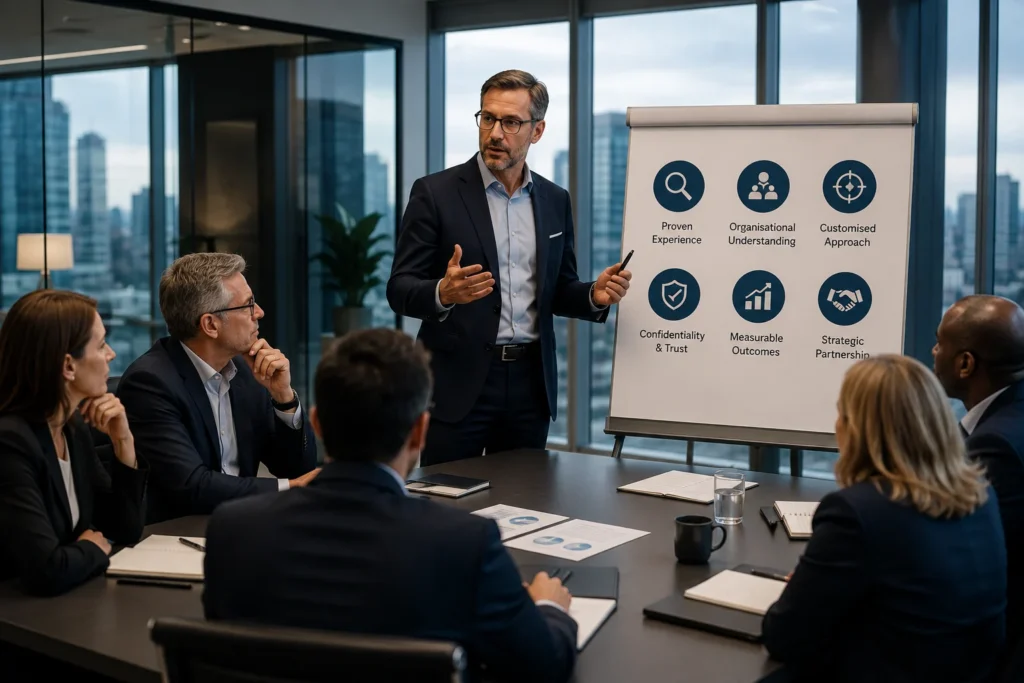
Not all executive coaching is equivalent. At the senior level, the choice of partner matters considerably.
Organisational Depth, Not Just Coaching Credentials
The most effective executive coaching for CEOs understands how organisations work: governance dynamics, board expectations, leadership risk, and the political realities of senior roles. Coaching certification alone does not provide this.
A Consulting-Led Model
Coaching that is led by experienced organisational consultants, rather than standalone coaches, is better equipped to connect leadership behaviour to business outcomes. The distinction is between someone who understands the individual and someone who understands the organisation that the individual is operating inside.
Bespoke Engagement Design
Senior leaders have specific contexts, specific gaps, and specific organisational pressures. Engagements should be designed around those realities, not delivered from a standard programme.
Confidentiality and Board-Level Trust
At senior levels, coaching conversations touch on governance sensitivities, performance concerns, and succession considerations. The ability to operate with complete discretion and to be trusted by boards and leadership teams in that capacity is not a given. It should be demonstrated, not assumed.
A Clear Measurement Framework
Any credible executive coaching consultant should be able to articulate, at the outset, how outcomes will be assessed and what success looks like for the specific engagement.
Why Organisations Choose Planet Ganges for Executive Leadership Coaching

Most coaching engagements are built around the individual. Planet Ganges takes a fundamentally different position: we start with the organisation.
Before any coaching begins, we establish the strategic priorities, governance context, performance expectations, and operating constraints the leader is working within. This is what separates development that produces real behavioural change from coaching that produces reflection without impact.
Senior leaders are evaluated through structured frameworks that examine decision-making patterns, leadership behaviour, and how their influence lands across the organisation. The feedback is evidence-based, confidential, and tied directly to the leader’s organisational context, not a generic competency scorecard.
Once the gaps are clearly mapped, we work on the specific behavioural shifts the leader needs to make in their current role and strategic context. Progress is reviewed at defined intervals against agreed business and leadership objectives, ensuring that what shifts during coaching stays shifted when the engagement ends.
This work is structured through the Planet Ganges DR²P framework (Develop, Review, Reward, Pivot), which embeds coaching within a broader system of accountability, structured review, and course correction over 12 to 36 months. This is what makes the difference between a coaching experience and a coaching outcome.
Our engagements routinely involve sensitive leadership conversations around governance, performance, and succession. Boards and leadership teams engage us because we operate with the rigour and discretion these conversations demand, with direct senior advisory involvement throughout, not junior delivery teams.
Conclusion
Leadership capability is not a soft input. It is an execution variable. Organisations that treat it as one invest deliberately in developing it at the senior level, through structured coaching that is tied to strategy, measured against real outcomes, and designed around the specific demands of the role.
If your organisation is navigating transformation, managing succession, or recognising that senior leadership effectiveness has become a constraint on growth, a focused conversation about what is driving the gap is the right starting point.
Planet Ganges works with boards and senior leadership teams to design and deliver executive leadership coaching that is built around your organisation’s strategic reality.
Frequently Asked Questions
What do executive coaching consultants do for senior leaders?
Executive coaching consultants assess how a senior leader currently thinks, decides, and operates within their organisational context, identify the behavioural gaps limiting their effectiveness, and support targeted development aligned with the organisation’s strategic priorities and governance expectations.
How is executive business coaching measured?
Outcomes should be defined before the engagement begins. Useful indicators include observable behavioural shifts assessed through structured stakeholder feedback, leadership effectiveness ratings before and after the engagement, and alignment with agreed business objectives and execution improvements.
How long does an executive business coaching engagement typically last?
Duration depends on the organisation’s objectives and the scope of development required. Most structured executive coaching engagements run over several months, long enough to support genuine behavioural change rather than temporary adjustment.
Is executive coaching only for underperforming leaders?
No. Many organisations engage executive coaching consultants for leaders who are already performing well but are being prepared for larger roles, navigating significant organisational change, or operating in high-stakes environments where even small improvements in judgment and influence have material impact.