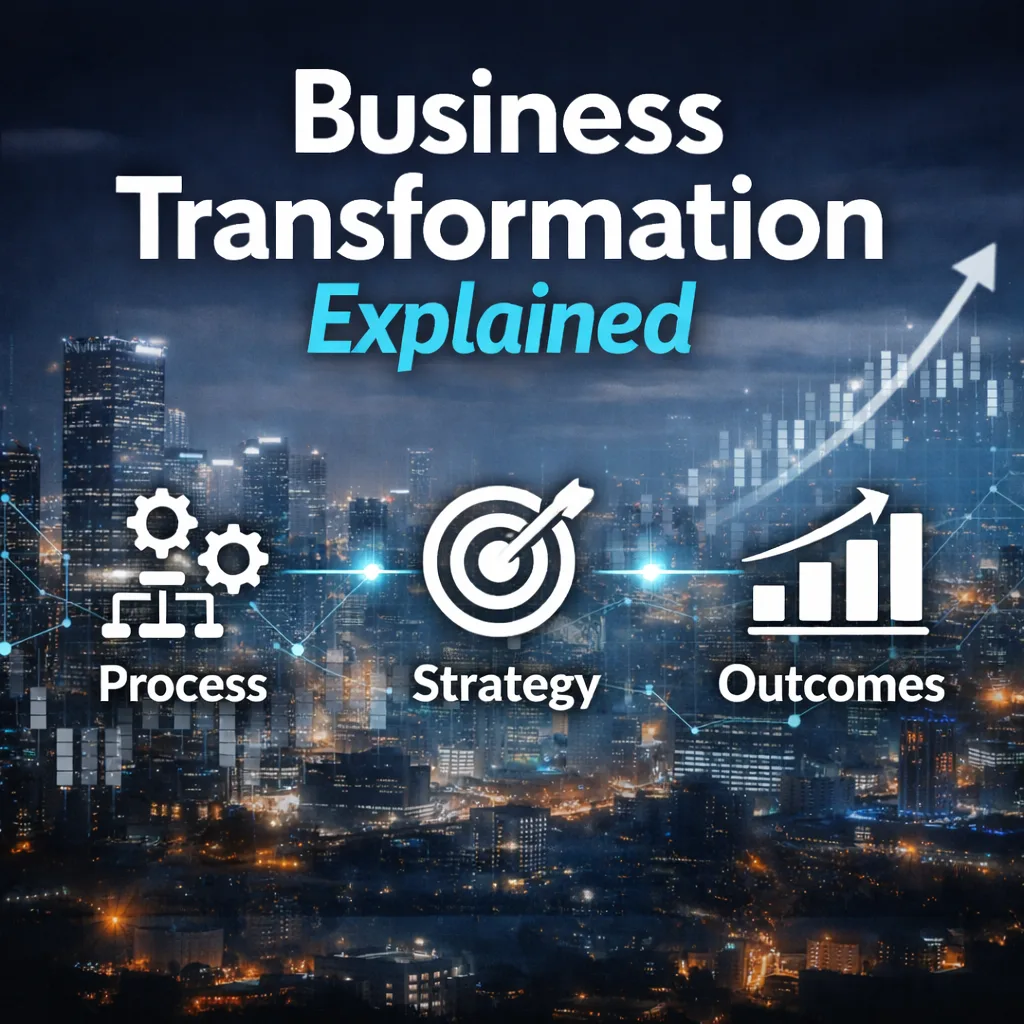

Business transformation is one of the most discussed goals in leadership rooms today. Yet most organisations quietly struggle to make it real. Growth targets increase. Complexity rises. Markets change faster than teams adapt. And somewhere between strategy decks and execution reviews, momentum starts to slip.
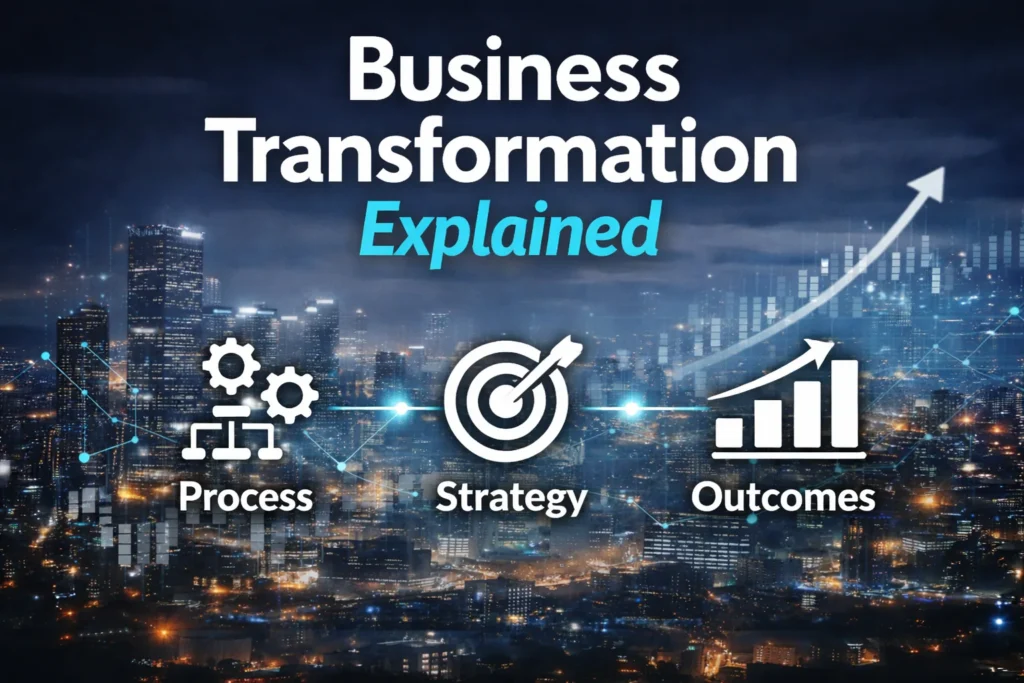
The real question is not whether transformation is needed. The real question is why it fails so often, even in well-led organisations.
This blog breaks down what business transformation truly involves, why most efforts stall, and what actually works under scale and execution pressure.
What Business Transformation Actually Involves?
Business transformation is not a single initiative or a technology upgrade. It is a fundamental shift in how an organisation thinks, decides, and executes as it grows.
At its core, business transformation touches four interconnected layers:
● Strategy and direction, including how ambition is defined and prioritised.
● Leadership behaviour, covering decision-making, ownership, and accountability.
● Operating systems, such as execution rhythm, reviews, and coordination.
● Culture and capability, which determine whether change sustains or fades.
When these layers move together, transformation becomes possible. When they move independently, results remain inconsistent.
Why Business Transformation Fails More Often Than It Succeeds?
Global research consistently shows that a majority of transformation efforts fail to deliver lasting impact. The reasons are rarely about poor intent or weak strategy.
Most failures follow familiar patterns.
1. Strategy changes, but leadership behaviour remains the same.
2. Execution systems do not evolve with scale and complexity.
3. Capability development lags behind growth ambitions.
4. Accountability depends on individual push instead of shared systems.
In many organisations, transformation becomes an added burden on leaders rather than a new way of operating. Over time, fatigue sets in and results in a plateau.
The Missing Link in Most Business Transformation Efforts
Many organisations invest heavily in strategy consulting, restructuring, or digital initiatives. What they often overlook is the leadership system required to sustain those changes.
The gap becomes clearer when we compare focus areas.
| Common Focus Areas | What Actually Drives Transformation |
| Strategy documents | Decision quality at senior levels |
| Org structure changes | Leadership alignment and ownership |
| KPIs and dashboards | Execution discipline and rhythm |
| Change programs | Capability and behaviour systems |
Business transformation succeeds when leadership systems evolve alongside strategy. Without that shift, execution depends on constant escalation and personal effort.
A Practical Business Transformation Process That Scales
A transformation that lasts follows a clear and repeatable process. While each organisation’s context differs, successful journeys usually move through five essential stages.
1. Diagnose reality honestly.
Understand leadership behaviour, execution gaps, and cultural friction as they exist today.
2. Redesign leadership and decision systems.
Clarify who decides what, how priorities are set, and how conflicts are resolved.
3. Align senior teams on direction and behaviour.
Build shared clarity on vision, strategy, and ways of working.
4. Build capability in a real business context.
Develop leaders using live challenges, not generic programs.
5. Reinforce change through reviews and rewards.
Install systems that sustain accountability and momentum.
This process shifts the transformation from a project mindset to an operating mindset.
Why Processes Alone Do Not Create Transformation?
Even well-designed strategies struggle when leadership systems are weak. Common breakdowns include:
● * Different leaders interpret priorities differently.
● * Decisions are being revisited instead of executed.
● * Growth depends on the CEO or founder’s push.
● * Capability gaps are widening as scale increases.
These issues are not solved by better planning. They are solved by changing how leadership teams operate together under pressure.
Business Transformation Strategies That Scale With Complexity
Most business transformation strategies fail not because they are poorly designed, but because they ignore leadership reality.
Strong strategies are built for scale, ambiguity, and execution pressure. They account for how decisions are made, how accountability travels, and how leadership capability evolves as complexity increases.
Effective business transformation strategies share five defining characteristics.
● They are future-anchored, not legacy-driven.
Strategy is shaped by where the organisation is going, not by what historically worked.
● They are matched to leadership capability.
Ambition is calibrated to the organisation’s ability to decide, align, and execute at scale.
● They prioritise execution rhythm over initiative volume.
Fewer priorities, clearly owned and consistently reviewed, outperform broad transformation agendas.
● They integrate behaviour into strategic choices.
Strategy and culture are not treated as separate tracks.
● They are designed to evolve with context.
As scale, markets, and organisational maturity change, strategy adapts without losing direction.
When business transformation strategies ignore these realities, execution weakens, and confidence erodes. When they account for them, transformation becomes predictable rather than episodic. This is where most organisations either stabilise or stall.
Introducing LACE: A Leadership System for Business Transformation
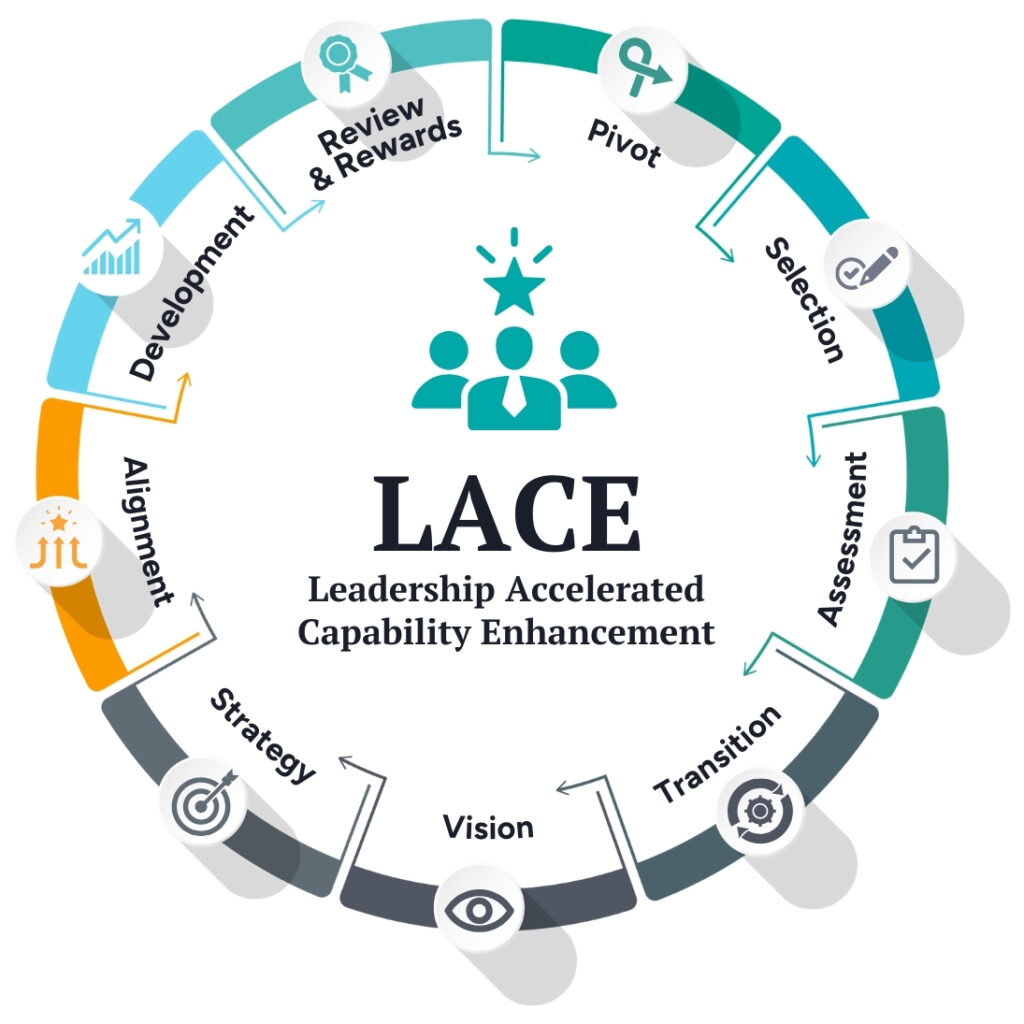
LACE stands for Leadership Accelerated Capability Enhancement. It is Planet Ganges’ comprehensive, industry-agnostic business transformation framework designed for organisations aiming for 5X to 10X growth over a 2 to 5 year horizon.
LACE exists because business transformation rarely fails due to a lack of strategy. It fails when leadership capability, culture, and execution systems do not evolve fast enough to support ambition.
Rather than treating transformation as a one-time initiative, LACE builds a sustained leadership system that aligns vision, strategy, behaviour, and execution into a single operating architecture.
How LACE Enables Business Transformation?
LACE approaches transformation through nine integrated leadership levers that strengthen how organisations hire, align, develop, and enable leaders.
These levers include:
● Search, focusing on purpose and cultural fit rather than titles.
● Assessment, using evidence-based evaluation to reduce leadership risk.
● Transition, accelerating integration, and early impact.
● Vision, creating a shared future direction.
● Strategy, translating ambition into executable plans.
● Alignment, enabling cohesive leadership action.
● Develop, and build context-rich leadership capability.
● Reviews and Rewards, reinforcing accountability and discipline.
● Pivot, supporting tough people and structure decisions when required.
Together, these levers ensure transformation is not dependent on individual heroics but embedded into how the organisation operates.
What Effective Business Transformation Delivers?
When organisations adopt a leadership-led transformation approach, the changes become visible and measurable.
Common outcomes include:
● Faster and clearer decision-making at senior levels.
● Stronger alignment between strategy and execution.
● Reduced dependency on the founder or CEO push.
● Leaders equipped to handle scale, complexity, and change.
● Predictable execution across functions and locations.
Transformation stops being reactive and becomes intentional.
For Whom Business Transformation Becomes Critical?
Business transformation becomes unavoidable for organisations facing specific growth and complexity thresholds, including:
● Fast-growing companies scaling across markets or locations.
● Founder-led businesses are professionalising leadership.
● Organisations preparing for M&A, restructuring, or IPOs.
● Leadership teams struggling with alignment and execution rhythm.
● HR and people leaders are driving culture and capability change at scale.
In these contexts, incremental improvement is no longer sufficient.
Business Transformation Is a Leadership System, Not an Initiative
Business transformation works when leadership continuity, capability, and execution discipline are designed into the organisation, not assumed.
Organisations that treat transformation as a leadership system reduce risk, protect momentum, and create sustainable growth. Those who treat it as a series of projects repeat the same struggles under new labels.
This is the difference between temporary change and lasting transformation.
If growth is outpacing organisational readiness, the answer is not more effort. It is a leadership system built to scale.