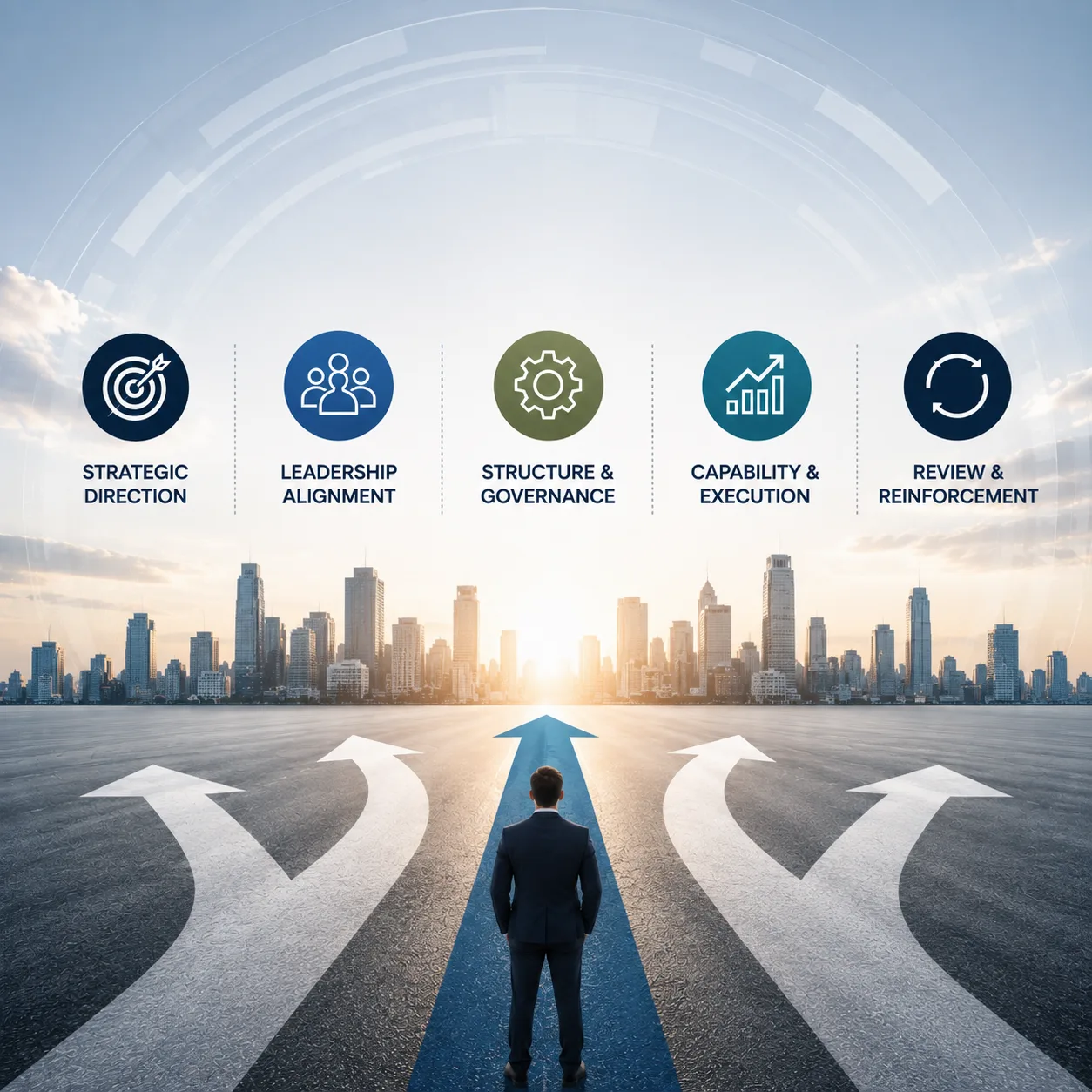

Business transformation is often described as a roadmap, a technology shift, or a restructuring initiative. In reality, it is a leadership discipline that reshapes how decisions are made, how accountability is enforced, and how execution becomes predictable.

This blog explains what a true business transformation process requires, why most efforts stall, and how a structured business transformation framework makes change sustainable.
What does a Business Transformation Process Really Involve?
A business transformation process is not a checklist of initiatives. It is a systemic shift in how leadership thinks, aligns, and executes under pressure.
At its core, transformation touches four interdependent layers that must move together for results to hold.
- Strategic direction and ambition clarity
- Leadership behaviour and decision quality
- Execution systems and review rhythm
- Culture and capability alignment
When these elements evolve in isolation, progress becomes uneven. When they are designed as one system, transformation gains momentum and consistency.
Why Most Business Transformation Processes Fail
Most organisations begin transformation with clarity and energy. Over time, execution slows because leadership systems remain unchanged.
Research consistently shows that nearly 70% of large transformation initiatives fail to sustain their impact. The reasons are structural rather than motivational.
Common failure patterns include:
- Strategy shifts, but leadership behaviour stays unchanged.
- KPIs exist, yet accountability mechanisms remain weak.
- Senior leaders interpret priorities differently across functions.
- Execution depends on the founder’s push instead of shared systems.
- Rewards reinforce short-term wins over enterprise outcomes.
These breakdowns reveal a deeper issue. The business transformation process was treated as a project rather than a leadership architecture.
A 7-Step Business Transformation Process That Scales With Complexity
A durable business transformation process must strengthen leadership capability while redesigning execution systems. The following seven steps provide a practical structure that scales across growth stages.
Step 1: Define Strategic Ambition and the Case for Change
Leaders must articulate why transformation is essential and what future success looks like. Without a shared narrative, resistance increases, and urgency fades.
Step 2: Diagnose Leadership and Capability Gaps
Transformation begins with an honest assessment. Leaders must evaluate decision quality, alignment levels, and execution bottlenecks before redesigning structures.
Step 3: Align Vision, Strategy, and Enterprise Priorities
Clarity at the top reduces friction across functions. A unified direction ensures that leadership teams interpret ambition consistently.
Step 4: Redesign Execution Architecture
Decision rights, review cadence, and ownership structures must be clearly defined. Execution rhythm replaces reactive escalation with disciplined follow-through.
Step 5: Build Leadership Capability in Context
Capability development must be rooted in real business challenges. Leaders grow faster when coaching, feedback, and learning are tied to live priorities.
Step 6: Reinforce Through Reviews and Rewards
Performance reviews should measure outcomes, not activity. Rewards must reinforce collaboration and enterprise-first behaviour.
Step 7: Enable Strategic Pivots Without Losing Momentum
When misalignment persists, decisive action protects credibility. Structured pivot decisions prevent cultural drift and execution fatigue.
This step-by-step business transformation process shifts change from initiative-driven to system-driven execution.
The LACE Business Transformation Framework Strengthens the Process
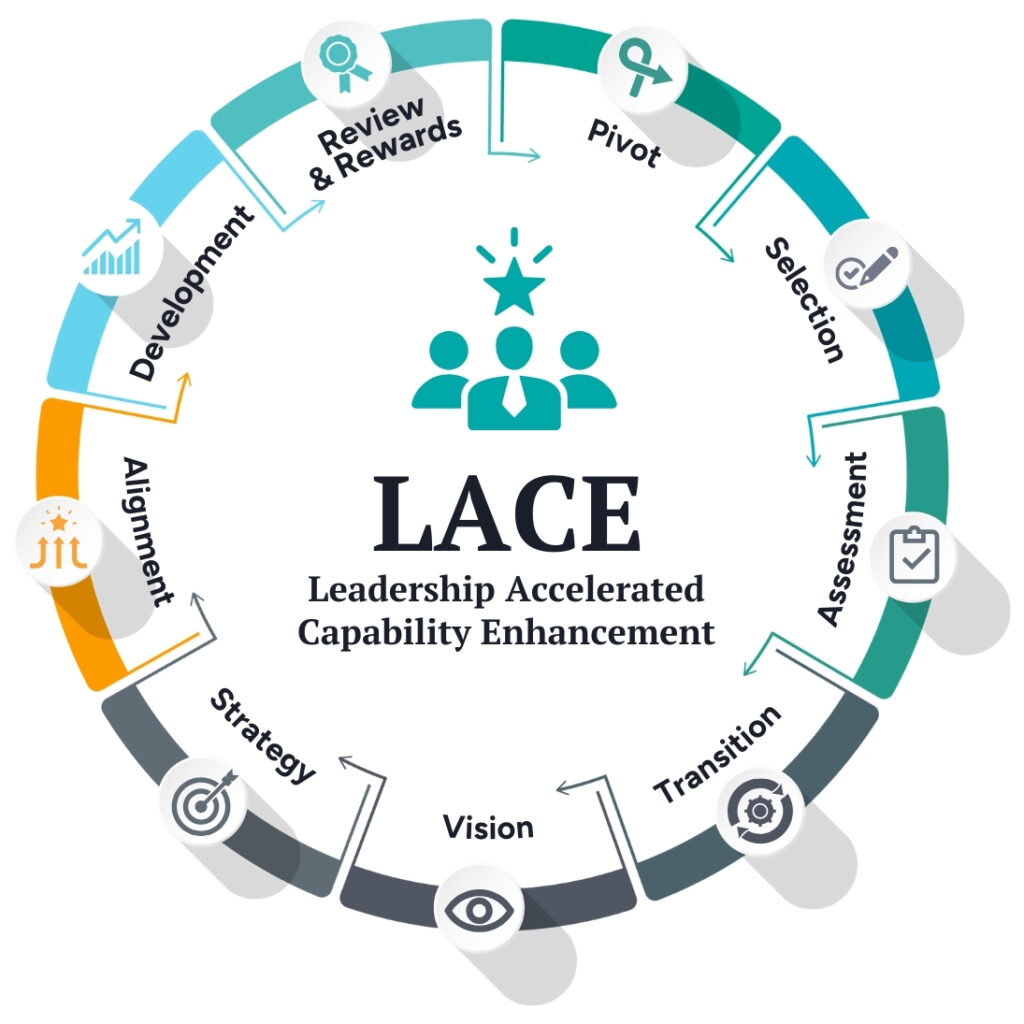
Many transformation models outline steps but fail to integrate them into a cohesive system. The LACE framework by Planet Ganges addresses this gap by aligning leadership capability, culture, and execution discipline.
LACE stands for Leadership Accelerated Capability Enhancement. It is designed for organisations targeting five- to tenfold growth over a two- to five-year horizon.
Unlike generic models, LACE connects nine integrated levers into one operating architecture:
- Search focused on cultural alignment and leadership fit.
- Assessment grounded in evidence-based diagnostics.
- Transition support that accelerates integration.
- Vision co-creation for shared strategic clarity.
- Strategy translation into executable plans.
- Alignment across senior leadership layers.
- Develop programs rooted in a real business context.
- Reviews and rewards that reinforce discipline.
- Pivot decisions guided by structured evaluation.
Organisations that implement this business transformation framework report stronger alignment, improved leadership effectiveness, and higher transformation success rates. The difference lies in integration rather than isolated initiatives.
Who Needs a Structured Business Transformation Process?
Transformation becomes critical when growth and complexity outpace leadership systems.
Organisations that benefit most include:
- CEOs scaling multi-location businesses.
- Founder-led companies are professionalising leadership layers.
- Firms preparing for mergers, IPOs, or restructuring.
- HR leaders driving enterprise capability shifts.
- Businesses are facing recurring execution inconsistency.
In these contexts, incremental improvements no longer deliver sustainable progress.
Business Transformation Process vs Business Transformation Framework
The terms are often used interchangeably, yet they serve different purposes.
A business transformation process outlines the sequence of actions required for change. It clarifies what must happen and in what order.
A business transformation framework ensures those actions are sustained over time. It embeds capability, alignment, and accountability into daily leadership behaviour.
Without a framework, the process becomes temporary. Without a process, the framework lacks structure. Sustainable transformation requires both.
Business Transformation Is a Leadership Discipline, Not a Project
Technology, restructuring, and new tools cannot compensate for weak leadership systems. Execution excellence emerges when leaders operate with shared clarity, disciplined reviews, and aligned incentives.
Transformation succeeds when leadership continuity, capability, and accountability are intentionally designed. It stalls when the change depends on energy rather than structure.
This distinction separates organisations that scale predictably from those that repeatedly restart initiatives.
Make Your Next Phase of Growth Intentional
If growth feels ahead of organisational readiness, the answer is not to put in more effort. It is a structured business transformation process supported by a leadership framework built for scale.
Planet Ganges helps organisations design transformation as a disciplined leadership system, not a temporary initiative. When leadership capability, alignment, and execution rhythm evolve together, sustainable growth becomes predictable rather than aspirational.
Frequently Asked Questions
The core stages include defining strategic ambition, diagnosing leadership gaps, aligning direction, redesigning execution systems, building capability, reinforcing accountability, and enabling timely pivots.
A business transformation framework is a structured system that integrates leadership alignment, execution discipline, and cultural reinforcement to sustain change over time.
Most meaningful transformation journeys unfold over twelve to thirty-six months, depending on organisational scale and complexity.
Failure typically results from misaligned leadership behaviour, weak review systems, and insufficient capability development rather than flawed strategy.
Leadership determines the speed, coherence, and sustainability of transformation by shaping decision quality, alignment, and accountability.