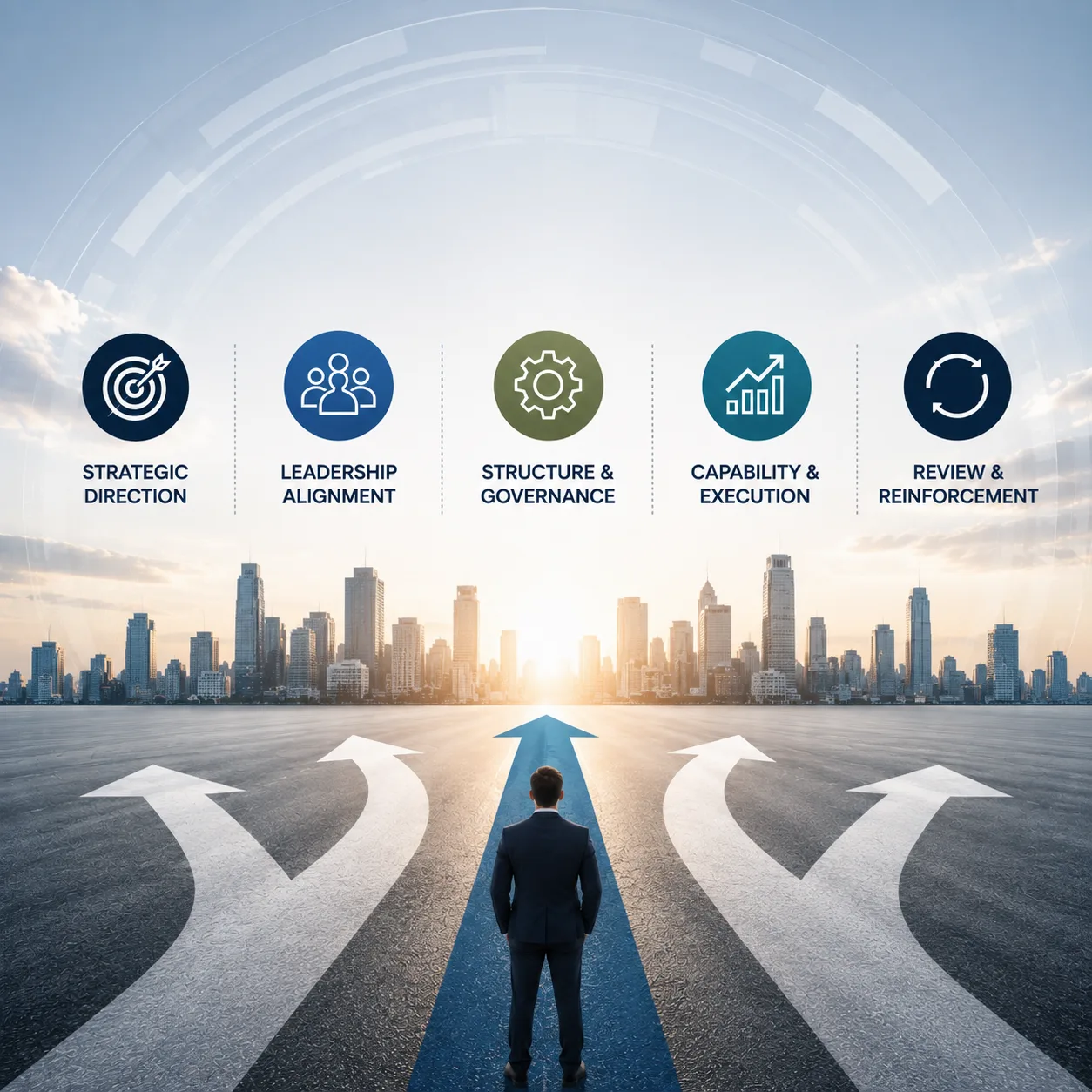

Every high-performing organisation shares one defining trait — the ability to convert ambition into disciplined execution. That ability rarely emerges on its own. It is built, deliberately, through strategic planning consulting.
When leadership teams invest in strategic planning consulting, they are not simply producing a strategic document. They are establishing the clarity of direction, the alignment of priorities, and the execution discipline that determine whether an organisation reaches its full potential, or continues to fall short of it. For business leaders navigating growth, transformation, or competitive pressure, this distinction matters enormously.
What Is Strategic Planning Consulting?
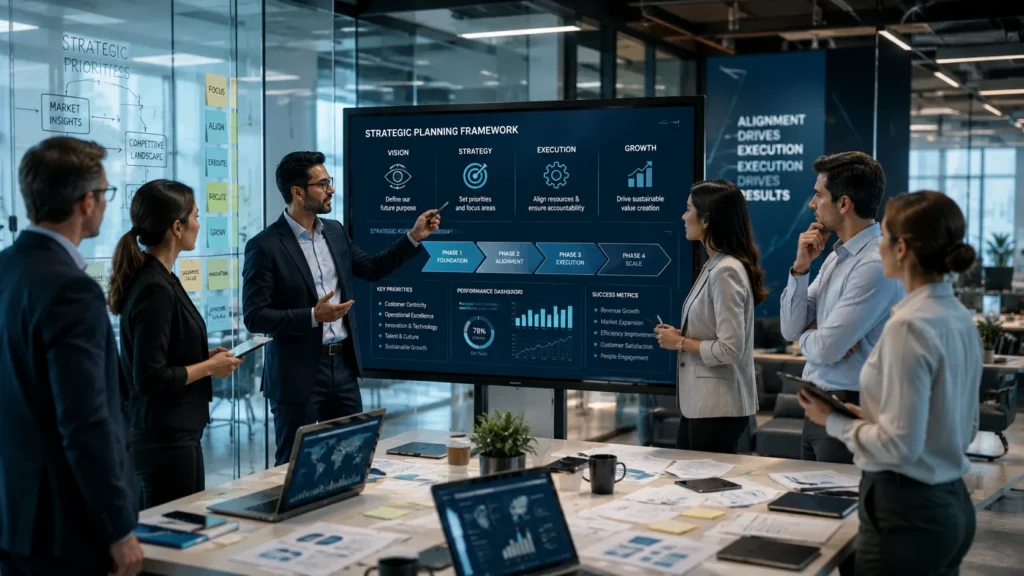
Strategic planning consulting is a structured engagement in which experienced consultants work alongside organisational leadership to define long-term direction, build an executable roadmap, and align decision-making at every level of the enterprise.
It begins with an honest diagnosis of where the organisation stands, its market position, internal capabilities, leadership cohesion, and structural gaps. From there, it moves through a rigorous process of vision-setting, strategic prioritisation, and alignment-building, culminating in a plan that leadership teams not only understand but are committed to executing.
The emphasis here is on execution. Effective strategic planning consulting does not conclude with the delivery of a report. It creates the conditions, the shared language, the accountability structures, and the governance mechanisms, that allow strategy to live and breathe within the organisation long after the engagement concludes.
The Strategic Challenges Most Organisations Face
Understanding the value of strategic planning consulting requires an honest look at the challenges that prevent otherwise capable organisations from growing at the pace their leaders envision.
Vision Without Execution
Many leadership teams have a compelling vision of where they want the organisation to go. The breakdown occurs in translating that vision into consistent action. Without a structured planning process, ambition remains aspirational rather than operational.
Leadership Operating Without Full Alignment
Senior leaders may share a common vision and yet interpret strategic priorities very differently. These divergent interpretations quietly shape decisions, resource allocation, and team behaviour, often in conflicting directions. The result is an organisation that appears aligned on paper but operates in friction.
Strategy Developed in Silos
When business units pursue goals in isolation, disconnected from broader market realities and enterprise priorities, strategic coherence breaks down. Duplication increases, collaboration decreases, and the organisation’s collective capacity is underutilised.
Accountability Without Clarity
Even well-designed strategies fail when decision rights are ambiguous and ownership is diffuse. Without explicit accountability, execution loses momentum, and attention shifts from proactive growth to reactive problem-solving.
Planning That Does Not Keep Pace with Change
Business environments evolve continuously. Organisations that treat strategy as a fixed annual exercise, rather than a dynamic, living system, find themselves executing plans that are increasingly disconnected from current realities. This is the gap Planet Ganges addresses through its leadership strategy and planning advisory work, which treats planning as a continuous discipline rather than an annual event.
These are not isolated failures of talent or intent. They are structural gaps that strategic planning consulting is specifically designed to close.
Key Benefits of Strategic Planning Consulting
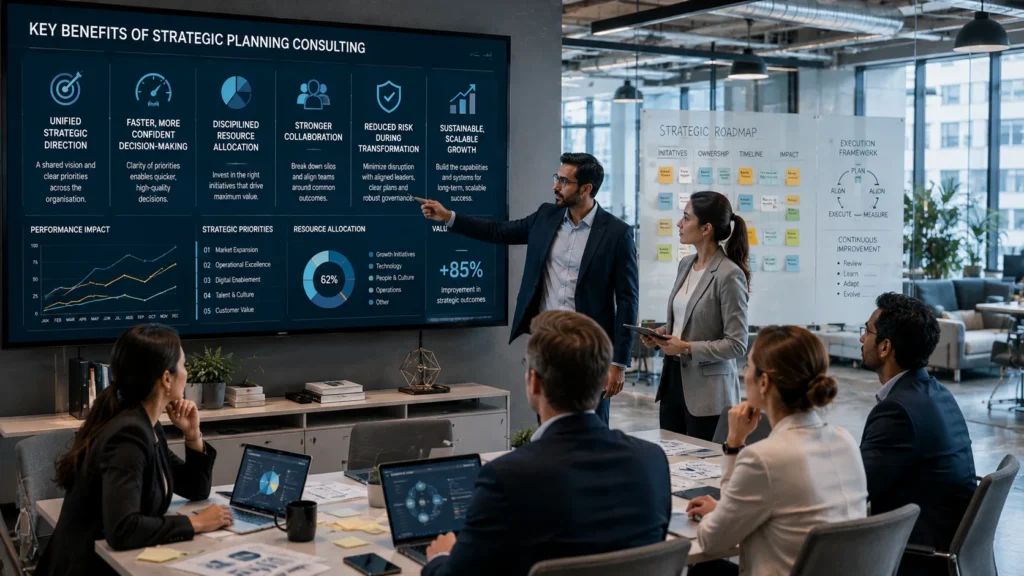
When strategic planning consulting is executed with rigor and discipline, the impact extends well beyond the planning process itself. Business leaders consistently report the following outcomes:
Unified Strategic Direction
When leadership teams work through a structured planning process together, they arrive at a genuinely shared understanding of the organisation’s direction, not just in headline terms, but in the specific trade-offs, priorities, and choices that define real strategy. This shared direction is the foundation everything else is built upon.
Faster, More Confident Decision-Making
When priorities are explicit and accountability is clear, the organisation’s decision-making velocity improves significantly. Leaders spend less time debating direction and more time advancing it. Cross-functional decisions that previously required extended negotiation become more straightforward.
Disciplined Resource Allocation
Strategic planning consulting brings rigor to one of leadership’s most consequential responsibilities, deciding where to invest the organisation’s finite resources. By aligning investment decisions to strategic priorities, organisations concentrate their effort on the initiatives most likely to generate value.
Stronger Cross-Functional Collaboration
When teams understand how their work connects to a shared organisational goal, collaboration improves organically. Functional leaders begin to coordinate around outcomes rather than compete for resources or influence.
Reduced Risk During Transformation
Organisational change is inherently risky. Strategic planning consulting mitigates that risk by ensuring leaders are aligned before transformation begins, on direction, on sequencing, on ownership, and on the metrics that define success.
Sustainable, Scalable Growth
Perhaps most importantly, strategic planning consulting installs the organisational habits, governance structures, and leadership behaviours that allow growth to be sustained over time. It moves organisations from opportunistic expansion to structured, scalable advancement. This is the broader outcome Planet Ganges works toward through its business transformation consulting practice, where strategy, culture, and capability evolve together.
The Role of a Strategic Planning Facilitator
There is a reason experienced organisations engage a skilled strategic planning facilitator rather than attempting to lead the planning process internally. The internal perspective, while essential, carries inherent limitations, historical assumptions, political sensitivities, and established power dynamics that can constrain the quality of strategic thinking.
A strategic planning facilitator brings structured neutrality to the process. Working alongside leadership teams, the facilitator creates an environment in which difficult conversations can be had productively, where assumptions are tested rather than accepted, and where the outcome is genuine commitment rather than surface-level consensus.
What distinguishes an effective strategic planning facilitator is not the ability to provide answers, but the discipline to ask the right questions, and the experience to guide leadership teams toward the clarity, alignment, and decisions that organisations need to move forward.
The facilitator’s role is also fundamentally practical. Sessions are designed to be decision-oriented, not merely reflective. Leaders leave with clear strategic choices made, priorities defined, and ownership established. That shift from conversation to commitment is often the most valuable contribution a facilitator makes.
How We Help Organisations With Our Strategic Planning Consulting Services
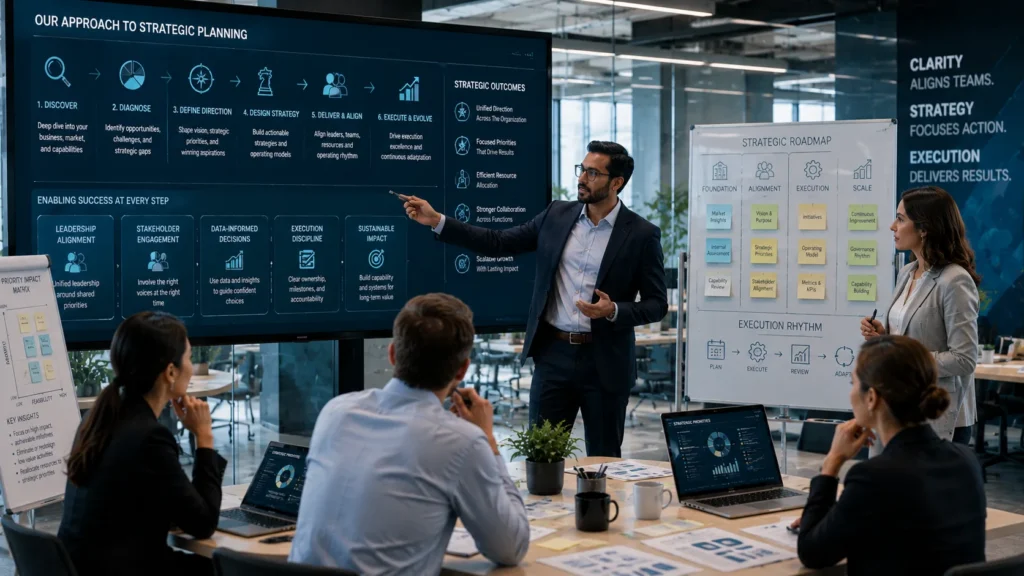
Planet Ganges is a business strategy consulting firm that works with fast-growing organisations to close the gap between strategic ambition and execution capability. The firm’s work is grounded in a core belief: that strategy, however well-designed, will only deliver results when leadership is genuinely aligned behind it.
The VSA Framework: Vision, Strategy, and Alignment
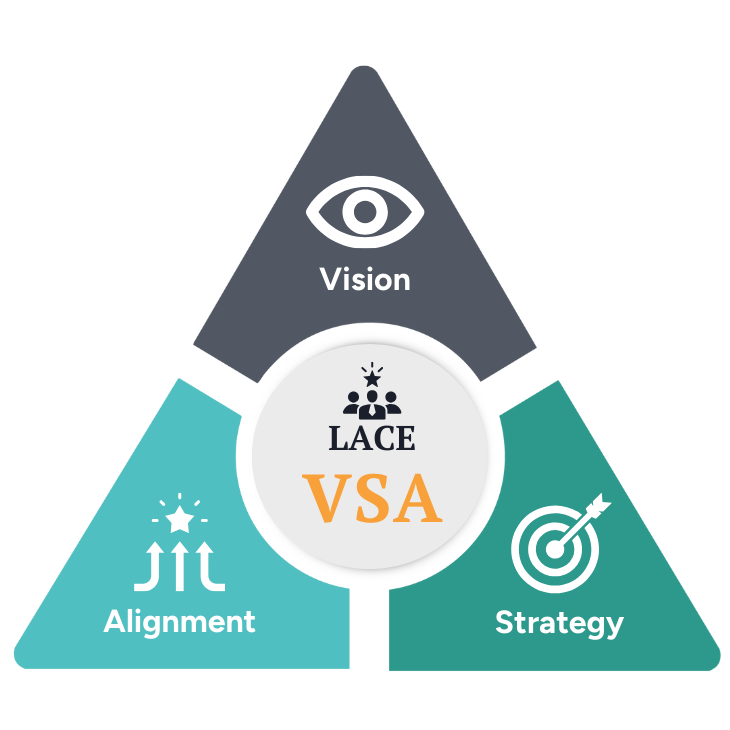
At the centre of our consulting methodology is a proprietary model called VSA, Vision, Strategy, and Alignment. This framework is designed to address the interconnected failures that most commonly prevent organisations from realising their strategic potential.
Vision establishes a clear, shared picture of where the organisation is headed. This is not a generic mission statement, it is a specific, substantive articulation of future direction that leadership teams actively co-create and commit to, including the trade-offs and priorities it implies.
Strategy translates that vision into an actionable roadmap. Planet Ganges brings market intelligence, competitive analysis, scenario planning, and structured leadership dialogue to develop strategies that are both ambitious and executable within the organisation’s cultural and operational realities.
Alignment ensures that senior leaders operate with shared accountability, not just shared understanding. This involves clarifying decision rights, aligning functional priorities to enterprise goals, and establishing the governance rhythm that keeps strategy connected to daily execution. At Planet Ganges, this governance rhythm is operationalised through DR²P (Develop, Review, Reward & Pivot), the framework that keeps strategic priorities under continuous review, reinforces accountability, and creates space for disciplined pivots as conditions change.
Critically, VSA is designed as a continuous system rather than a linear process. Vision, strategy, and alignment are not set once and left unchanged. They are revisited and refined as business conditions evolve, performance data informs decisions, and leadership teams grow in their strategic capability.
When to Consider Strategic Planning Consulting?
Strategic planning consulting delivers the greatest value when organisations are at a genuine inflexion point, when the complexity of the business has outgrown the planning processes that previously served it.
Consider whether any of the following reflects the current reality of your organisation:
- Growth has plateaued, and leadership does not have a clear diagnosis of why
- The senior team holds differing views on strategic priorities, even if those differences are not openly acknowledged
- Strategy exists as a document, but is not consistently driving decisions or resource allocation
- The organisation is entering a period of significant change, expansion, restructuring, leadership transition, or market shift
- Leadership is aligned on ambition, but lacks a shared, executable roadmap for achieving it
These are not signs of organisational weakness. They are indicators that the organisation has reached a stage of complexity that demands a more rigorous, structured approach to strategy, one that strategic planning consulting is specifically designed to provide.
Final Thoughts
The gap between where an organisation is and where its leaders believe it can be is rarely a talent gap. It is almost always a strategy and alignment gap.
Strategic planning consulting, when approached with genuine rigour, closes that gap. It gives leadership teams the clarity to make better decisions, the alignment to act on those decisions consistently, and the accountability structures to ensure execution follows through. A skilled strategic planning facilitator does not impose a direction, they create the conditions for leadership to define one, commit to it, and build the organisational capacity to realise it.
For organisations serious about sustainable, scalable growth, Planet Ganges offers exactly that, a consulting practice built on the understanding that strategy is not a document to be delivered, but a capability to be built.
Frequently Asked Questions
Q1. What is strategic planning consulting?
Strategic planning consulting is a structured engagement in which experienced consultants work with an organisation’s leadership to define long-term direction, develop an actionable strategy, and align teams to execute it with discipline. It addresses both the design and the delivery of strategy.
Q2. How does strategic planning consulting differ from general business consulting?
General business consulting typically addresses specific operational or functional challenges. Strategic planning consulting takes an enterprise-wide view, it focuses on where the organisation is going, the choices required to get there, and whether leadership is genuinely aligned to make those choices consistently.
Q3. What does a strategic planning facilitator do?
A strategic planning facilitator guides leadership teams through structured planning processes, helping them think clearly, surface assumptions, make explicit strategic choices, and leave sessions with real commitments and defined accountability. The facilitator’s value lies in the quality of the questions asked and the discipline applied to reaching actionable outcomes.
Q4. When should an organisation engage a strategy consultant?
The right time to engage a strategic planning consultant is when the organisation faces a genuine inflexion point: a growth plateau, significant leadership misalignment, a major market or operational transition, or a persistent gap between strategic intent and execution. Waiting for a crisis to prompt the engagement is itself a strategic risk.
Q5. How long does a strategic planning consulting engagement typically take?
The duration depends on the scope and complexity of the engagement. An initial diagnostic can be conducted relatively quickly. A comprehensive engagement covering vision, strategy, and alignment typically spans six to eighteen months, ensuring that the work extends beyond planning to influence leadership behaviour and execution.
Q6. What outcomes can business leaders expect from strategic planning consulting?
Leaders consistently report stronger alignment on organisational priorities, faster and more confident decision-making, more disciplined resource allocation, and improved cross-functional collaboration. Over time, these operational improvements translate into measurable growth and more predictable financial performance.