
The future of banking, financial services and insurance in India and the Gulf will be shaped less by how many people institutions can reach and more by how deeply, responsibly and profitably they can serve them. The access era built accounts, payment rails and formal participation. The depth era must turn that access into useful credit, protection, savings, advice and long-term customer value.
For leadership teams, this is not simply a technology upgrade. It is a shift in economics, operating models, risk discipline and talent. The institutions that move early will treat digital transformation as a coordinated business programme—one that connects customer strategy, data, governance, execution and leadership—rather than a collection of apps and vendor projects.
This guide explains what “access to depth” means across banking, fintech and insurance; why India and the Gulf increasingly belong in the same strategic conversation; which risks boards need to manage; and what leaders should do now to prepare for 2030.
What Does Moving from Access to Depth Mean for BFSI Leaders?

Access asks whether a customer can enter the formal financial system. Depth asks whether the institution can solve more of that customer’s financial needs—at a price the customer can afford and with economics the institution can sustain.
That changes the scoreboard. Accounts opened and transactions processed still matter, but they are no longer enough. Leaders must also track active usage, products per customer, cost-to-serve, risk-adjusted revenue, retention, claims experience and customer trust.
Table 1. The access and depth eras reward different capabilities.
| The access era | The depth era | |
|---|---|---|
| Primary goal | Include more people | Serve customers deeply and profitably |
| Scarce resource | Reach and a licence | Trusted data, risk judgement and leadership |
| Winning move | Open accounts and build rails | Convert activity into credit, savings, wealth and protection |
| Board metric | Accounts and transaction volume | Risk-adjusted value per active customer |
Where Do BFSI Markets in India and the Gulf Stand Today?
The shift begins from a position of strength. India has near-universal account access, enormous payment scale and healthier bank balance sheets than it had a decade ago. The Gulf combines modern payment infrastructure, high wealth density, state-backed investment and a fast-growing fintech ecosystem. Those strengths create room to build; they do not guarantee that institutions will capture the opportunity.
Table 2. Selected market signals. Figures are dated because these indicators change frequently.
| Indicator | Latest defensible figure | Leadership implication |
|---|---|---|
| India UPI activity | 23.20 billion transactions worth ₹29.90 lakh crore in May 2026 | The payment rail has scale; value must come from services built around it. |
| India account ownership | About 90% of adults in the 2024 Global Findex survey | Usage and product depth matter more than opening another basic account. |
| Indian bank health | GNPA 2.42% and CRAR 16.43% in December 2024 | A strong balance-sheet window can fund capability building. |
| Saudi fintech ecosystem | 261 active fintech companies at end-2024 | Competition and partnership options are expanding quickly. |
| Saudi PIF scale | US$913 billion in assets under management at end-2024 | State capital continues to shape market development and cross-border opportunity. |
Three conclusions follow. First, reach is no longer the principal constraint. Second, a strong system can still contain weak customer economics. Third, public infrastructure makes basic technology easier to access, so execution quality becomes more important as a source of advantage.
Why Has Access Stopped Being the Main Growth Story?
When almost nine in ten adults have an account and billions of payments move each month, another account or wallet adds limited strategic value by itself. The larger opportunities sit behind the access layer: appropriate credit for thin-file customers, protection for underinsured households, wealth products for new investors, and advice that customers can trust.
This is why the next phase will be harder. Building reach rewards distribution and scale. Building depth requires institutions to understand customer needs, use consented data responsibly, price risk well, redesign operations and earn the right to cross-sell. It also requires leaders to decide which customer segments and profit pools they will not pursue.
What Does Depth Mean in Banking?
In banking, depth means converting an account or payment relationship into a broader, durable relationship across deposits, credit and wealth—without allowing acquisition costs, legacy processes or credit losses to erase the margin.
For banks and NBFCs, digital banking transformation should therefore start with economics, not interfaces. A better mobile journey is valuable, but it cannot compensate for slow underwriting, fragmented data, manual servicing or a core platform that makes small-ticket products unprofitable.
A Practical Sequence for Digital Banking Transformation
- Fix the cost-to-serve. Simplify high-volume journeys, automate repeatable work and modernise the systems that create avoidable manual effort.
- Build a governed data foundation. Use consented customer and transaction data to improve underwriting, personalisation and early-warning signals.
- Deepen the relationship. Expand from payments and deposits into suitable credit, savings and wealth products based on customer need—not blanket cross-selling.
- Scale with risk controls. Strengthen model governance, collections, cyber resilience and conduct oversight before volumes accelerate.
A digital bank may begin with cleaner technology, but it faces the same enduring tests: stable funding, disciplined risk, customer trust and a credible route to profit. Incumbents and challengers are converging on the same destination from different starting points.
What Does Depth Mean in Financial Services and Fintech?
Across payments, lending, wealth, asset management and capital markets, depth is the move from transaction volume to sustainable value. A large user base is not a business model unless the institution can explain what customers will pay for, what risks it is taking and how the economics improve as it scales.
For fintech leaders, the board question has changed from “How fast are we growing?” to “Which profit pool do we have the right to win?” Payments can open the relationship, but value is more likely to come from carefully designed credit, merchant services, wealth, embedded finance or infrastructure. Each carries different regulatory, capital and trust requirements.
This is also where digital transformation becomes organisational. Product, risk, compliance, finance and technology teams must work to the same unit-economics model. If growth metrics sit with one team and losses or compliance costs sit with another, scale can hide rather than solve the problem.
What Does Depth Mean in Insurance?
Insurance has the widest gap between formal access and meaningful use. The opportunity is not simply to sell more policies. It is to lower the cost of distribution, improve underwriting, make claims faster and fairer, and design products that customers understand and can sustain.
India’s 2025 insurance-law reform permits up to 100% foreign investment, subject to the applicable conditions. The Bima Sugam regulatory framework also points towards a more connected digital marketplace. Leaders should treat these developments as enablers, not substitutes for execution. Capital and a marketplace cannot fix unclear products, poor claims experience or weak distribution economics.
In the Gulf, the growth agenda includes conventional insurance, mandatory health coverage and takaful. Product design must reflect local regulation and Shariah principles, while operating platforms need enough flexibility to support multiple markets without creating a separate cost base for each one.
Table 3. “Depth” means something different in each part of BFSI.
| BFSI domain | The depth problem | The growth move |
|---|---|---|
| Banking | Legacy cost and fragmented data make small relationships unprofitable | Turn account activity into risk-disciplined credit, deposits and wealth |
| Financial services and fintech | Scale is not consistently linked to profit | Choose monetisation pools and manage unit economics before accelerating |
| Insurance | Distribution, underwriting and claims remain expensive or hard to trust | Design affordable products and modernise the full policy-to-claim journey |
How Are India and the Gulf Converging into One Financial Market?
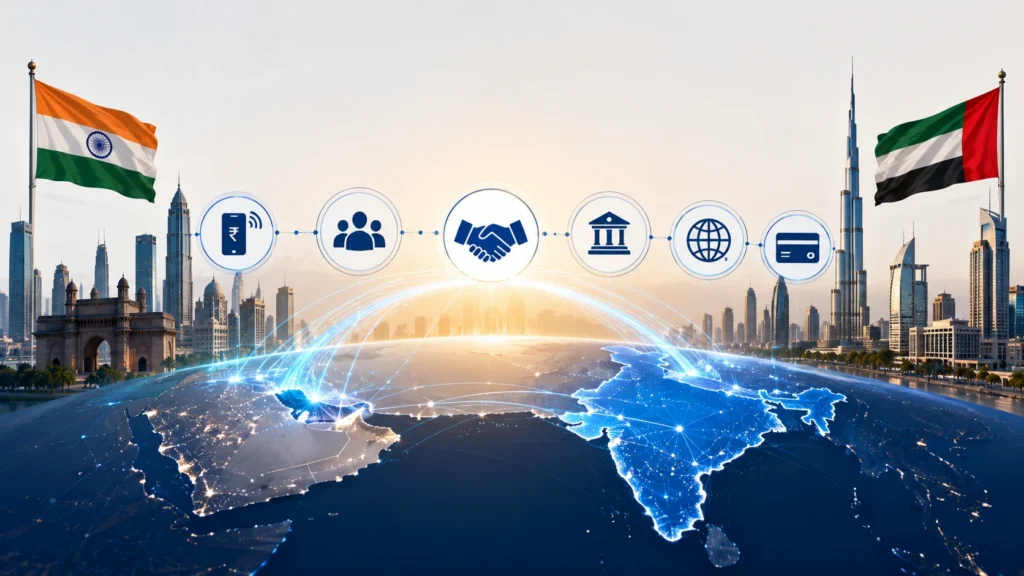
India and the Gulf are not identical markets, but their financial systems are becoming more connected. India built public digital infrastructure at population scale. Gulf markets combine state-directed development, high capital availability, global-hub ambitions and a strong Islamic-finance identity.
The corridor is moving from people and trade towards infrastructure and capital. In 2023, the Reserve Bank of India and the Central Bank of the UAE agreed frameworks for local-currency trade settlement and payment-system connectivity. Saudi Arabia’s financial-sector programme reported 261 active fintech companies by the end of 2024, while the UAE continues to develop instant and cross-border payment capabilities.
For institutions active in both regions, the implication is practical: plan the corridor as one strategy with local adaptations. Reuse data, risk, technology and leadership capabilities where regulation permits, while tailoring product, licensing, distribution and Shariah requirements market by market.
Table 4. Different starting points, increasingly connected opportunities.
| India | The Gulf | |
|---|---|---|
| Core driver | Inclusion and scale on public digital rails | Diversification, hub ambition and state-backed investment |
| Strategic strength | Large customer base and deep technology talent | Capital, wealth density and cross-border position |
| Distinctive requirement | Low-cost delivery across diverse customer segments | Local regulation, Islamic finance and market-specific partnerships |
| Shared destination | Trusted, data-led, profitable financial relationships | Trusted, data-led, profitable financial relationships |
What Are the Biggest Risks BFSI Leaders Must Manage?
A strong starting position can create complacency. The most important risks are not arguments against investing; they are design conditions for investing well.
- Credit risk: rapid growth in unsecured, microfinance or newly originated portfolios can deteriorate before headline system ratios show it.
- Profitability risk: volume can grow faster than a credible revenue model, particularly in payments and subsidised acquisition channels.
- Operational and cyber risk: shared rails and concentrated providers increase the consequence of outages, fraud and third-party failure.
- Regulatory and conduct risk: consent, explainability, product suitability and fair treatment become harder as data and AI influence decisions.
- Execution risk: disconnected programmes compete for funding, talent and leadership attention, creating activity without enterprise outcomes.
- Cross-border risk: rules, data-localisation requirements, licensing and Shariah expectations differ even when the market opportunity looks connected.
What Will BFSI Look Like by 2030? Five Predictions
Forecasts should guide decisions, not pretend to eliminate uncertainty. These five predictions describe the direction we expect and the signal leaders should monitor.
- Payments will become the relationship layer, not the final product. Watch the share of payment users who adopt responsibly priced credit, merchant or wealth services.
- Credit will deepen through consented data and partnerships. Watch early delinquency, model performance and customer outcomes—not only disbursement growth.
- Insurance will begin to convert reform into wider use. Watch renewal, claims satisfaction and a sustained improvement in penetration rather than policy sales alone.
- Islamic finance and sukuk will expand the Gulf’s role in global capital markets. Watch new issuance, sustainable-finance structures and cross-border investor participation.
- AI will widen the performance gap, but only where data and operating models are ready. Watch the cost-to-income, fraud, service and risk-decision gap between leaders and laggards.
By 2030, the strongest digital bank will not necessarily be the institution with the newest stack. It will be the one that combines technology with trusted data, disciplined risk, clear product economics and reliable execution.
Why Is Leadership, Not Technology, the Real Differentiator?
Infrastructure is becoming easier to buy or share. Public rails, cloud platforms and AI models are available to many competitors. What remains scarce is the leadership judgement to choose a position, sequence investment, manage risk and sustain change after the initial launch.
Most programmes do not fail because no one selected a vendor. They fail because leaders disagree on outcomes, governance is unclear, critical roles are missing, or the organisation cannot change its routines. That is why leadership architecture belongs at the start of a digital transformation plan, not in the final “people” workstream.
Planet Ganges supports this work through business transformation consulting, executive leadership coaching and specialist C-suite executive search for financial-services organisations.
What Should BFSI Leaders Do Now?
The immediate task is to convert a broad market thesis into a small number of sequenced decisions. A board or executive committee can begin with five questions:
- Where do we have access without depth? Identify segments with high account or transaction activity but low value, weak retention or poor customer outcomes.
- Which profit pools fit our right to win? Choose the products where data, distribution, risk capability and trust reinforce one another.
- What must be fixed before we scale? Be explicit about core systems, cost-to-serve, data governance, risk controls and leadership gaps.
- Which capabilities should be shared across India and the Gulf? Separate reusable platforms and talent from market-specific regulation and distribution.
- Who owns the result? Assign one accountable executive, measurable outcomes and a review cadence that connects the programme to business performance.
Table 5. A starting agenda for the move from access to depth.
| Institution | Priority now | Measure of progress |
|---|---|---|
| Banks and NBFCs | Reduce cost-to-serve; deepen suitable credit, deposit and wealth relationships | Risk-adjusted value per active customer |
| Fintech and financial services | Prove the revenue model and unit economics before scaling | Contribution margin and retention by product |
| Insurers and insurtechs | Integrate distribution, underwriting and claims modernisation | Renewal, claims experience and acquisition cost |
| Boards | Align strategy, leadership, governance and capability | Decision speed, milestone delivery and realised business value |
Conclusion
The access era made financial participation possible at unprecedented scale. The depth era will determine whether that infrastructure creates durable value for customers, institutions and economies.
The winners in the future of BFSI will not be separated by technology alone. They will be the institutions that use trusted data well, maintain risk discipline, choose clear profit pools, connect India and the Gulf thoughtfully, and build leaders who can carry strategy into operating reality.
If your board or leadership team is deciding how to sequence the next phase of growth, Planet Ganges can help translate the access-to-depth opportunity into a transformation roadmap, the leadership capability to execute it, and the governance required to sustain results.
Frequently Asked Questions
What Does BFSI Mean?
BFSI stands for banking, financial services and insurance. It includes banks, NBFCs, payment companies, fintech firms, wealth and asset managers, capital-markets businesses, insurers and related institutions.
What Does “Access to Depth” Mean in BFSI?
Access means giving customers an account, payment method or entry point into formal finance. Depth means meeting more of their borrowing, saving, investment and protection needs responsibly and profitably.
How Should a Bank Begin Digital Banking Transformation?
Begin with the customer and the economics. Reduce the cost-to-serve, fix fragmented data and high-friction journeys, then deepen suitable products with strong risk and conduct controls. Technology choices should follow that sequence.
How Can Fintech Companies Improve Profitability?
Choose a clear profit pool, measure full unit economics by product and customer cohort, and avoid treating user or transaction growth as proof of value. Payments may open the relationship, while revenue can come from credit, merchant services, wealth, embedded finance or infrastructure—each with different risks.
Why Are India and the Gulf Strategically Connected?
Trade, capital, talent and payment infrastructure increasingly connect the two regions. Institutions can share selected platforms and capabilities while adapting products, regulation, licensing and distribution to each market.
Why Does Leadership Matter in BFSI Transformation?
Because technology is only one component of change. Leaders must choose priorities, make trade-offs, align risk and growth, redesign accountability, build capability and maintain execution over multiple years.
Sources for Deployment and Fact Review
These links support the time-sensitive figures and policy statements in the article. The deployment team should retain the relevant inline links and recheck changing statistics immediately before publication.
NPCI — UPI Product Statistics — May 2026 transaction volume and value.
World Bank — Global Findex 2025 — India account-ownership context based on the 2024 survey.
Reserve Bank of India — April 2025 Monetary Policy Press Release — December 2024 system-level GNPA and capital ratios.
Government of India, PIB — Insurance-law amendment — Parliamentary approval of up to 100% FDI in insurance in December 2025.
IRDAI — Bima Sugam Regulations, 2024 — Regulatory framework for the insurance electronic marketplace.
Saudi Vision 2030 — Financial Sector Development Program Annual Report 2024 — 261 active fintech companies at end-2024.
Public Investment Fund — 2024 Annual Report release — US$913 billion assets under management at end-2024.
Central Bank of the UAE — India/UAE MoUs — Local-currency settlement and payment-system cooperation announced in 2023.