

Most CEOs and Founders do not lack vision. They lack synchronization. You have sat through the strategy meeting where everyone aligned, only to find two weeks later that departments are pulling in different directions.
When your top team is out of sync, the organization develops a drag — slower execution, diluted capital, compounding operational friction. If you are carrying the weight of alignment alone, these signs deserve your attention.
What Is Leadership Misalignment?
Leadership misalignment is the gap between what the business aims to achieve and how the leadership team actually operates.
It surfaces when leaders do not share the same definition of success — priorities split, decisions stall, execution fragments. That is different from disagreement. Strong teams disagree, then commit. Misaligned teams agree in the room and quietly pursue separate agendas outside it. Over time, each function optimizes for itself.
10 Signs Your Organization Has Leadership Alignment Issues
Misalignment rarely announces itself. It accumulates in patterns — some obvious, some easy to rationalize away.
1. Leaders Are Stuck on the Same Issue
If your leadership team keeps revisiting a topic that was supposedly settled in a previous meeting, do not ignore it. This is rarely a communication problem. It indicates that your team lacks a shared commitment to the path forward. Agreement in the room does not always mean alignment outside it.
2. The Team Is Winning Individually, But the Organization Is Not
The Sales VP is hitting their numbers, but the Product team is behind, and the CFO is concerned about burn. When individual leaders celebrate their own wins while the organization misses its overall targets, you have a critical organizational alignment issue. Functional success masking enterprise failure is one of the most dangerous and overlooked misalignment patterns.
3. Every Decision Comes Back to the CEO
When leaders are unclear about their authority — or do not trust peer-level decisions — the CEO absorbs everything. Minor operational calls. Approvals that should not require the top of the house. This is not a sign of indispensable leadership. It means accountability has not been meaningfully distributed.
4. Your Top Leaders Cannot Agree on the Organization’s Priorities
Ask your top five leaders to list the organization’s top three priorities for the quarter. If you receive five different answers, your strategy exists only on paper. When leaders carry different mental models of what matters most, every decision they make reinforces misalignment further down the organization.
5. Strategy Exists, But Execution Does Not Follow
There is a clear vision at the top. But nothing changes in how teams operate day to day. Leaders are not translating strategy into real operational behavior. The gap between strategic intent and daily execution is almost always a people and alignment problem — not a planning problem.
6. Leaders Are Running Their Own Agendas
Some leaders are quietly allocating team time and budget to initiatives disconnected from the shared strategy. These shadow priorities consume real resources. What makes them dangerous is not the waste — it is the signal they send. When the leadership team tolerates misaligned spending, it tells the rest of the organization that alignment is optional.
7. Your Best Middle Managers Are Leaving
Senior talent is retained. But strong middle managers — the people who translate leadership decisions into team execution — are quietly exiting. Not because of workload, but because of changing priorities and mixed signals from above. When the leadership team is misaligned, friction accumulates in the middle of the organization first. This layer is your early warning system.
8. More Communication, Less Clarity
More emails. More meetings. More status updates. Yet no one is clear on what has been decided, by whom, or why. Volume is not the problem. The problem is that leadership has not established a shared language for priorities, decisions, and accountability — so more communication just distributes the confusion faster.
9. Direction Shifts With Every Market Signal
When leaders are misaligned on internal priorities and trade-offs, every external development — a competitor move, a market shift, a board conversation — can trigger a direction change. Over time, people stop committing fully because they do not trust that today’s priority will still matter tomorrow. The root cause is not the market. It is the absence of a stable internal anchor for decision-making.
10. Decision-Making Stalls Across Functions
Critical projects rotate between departments without resolution. Because no single leader has clear ownership, initiatives sit in limbo. Reviews happen, but nothing moves. This is one of the most visible and costly symptoms of leadership alignment failure — and one of the last to be addressed, because everyone assumes it is someone else’s problem.
Why Leadership Alignment Fails
Leadership alignment problems are structural. They are not about personality fit or willingness to collaborate.
Unspoken assumptions about execution. Leaders often assume they are aligned on the How just because they agreed on the What. Without explicit definitions of the trade-offs involved, those assumptions eventually clash at the operational level.
Misaligned incentives. If the Head of Sales is paid purely on top-line revenue while the CEO wants profitable growth, the system is structurally designed to create conflict — regardless of how many alignment workshops the team attends.
Avoidance of difficult conversations. Many leadership teams choose harmony over honesty. Conversations about resource allocation, underperformance, and strategic trade-offs get deferred — and the misalignment compounds each quarter they go unaddressed.
Weak review rhythms. If strategy surfaces only at the annual offsite, alignment drifts by default. A disciplined review cadence is not a bureaucratic overhead — it is the mechanism that keeps leadership pointed in the same direction as conditions change.
Unclear decision rights. When leaders are unsure who owns what, they either escalate everything to the CEO or avoid accountability altogether. Both outcomes paralyze execution and reinforce every misalignment pattern described above.
The Cost of Ignoring Misalignment
Ignoring these signs is expensive. It shows up on your balance sheet in several ways.
Lost revenue opportunities. While your team is debating internal roles, competitors are moving faster to capture market share.
Slower time-to-market. Friction between Product, Marketing, and Sales adds weeks or months to every launch.
Employee disengagement. Talent thrives on clarity. When leaders provide conflicting signals, engagement drops and your best people disengage long before they hand in their resignation.
Strategy failure. Most strategies do not fail because they were wrong. They fail because the leadership team was not synchronized enough to execute them.
How Planet Ganges Helps You Build Lasting Leadership Alignment
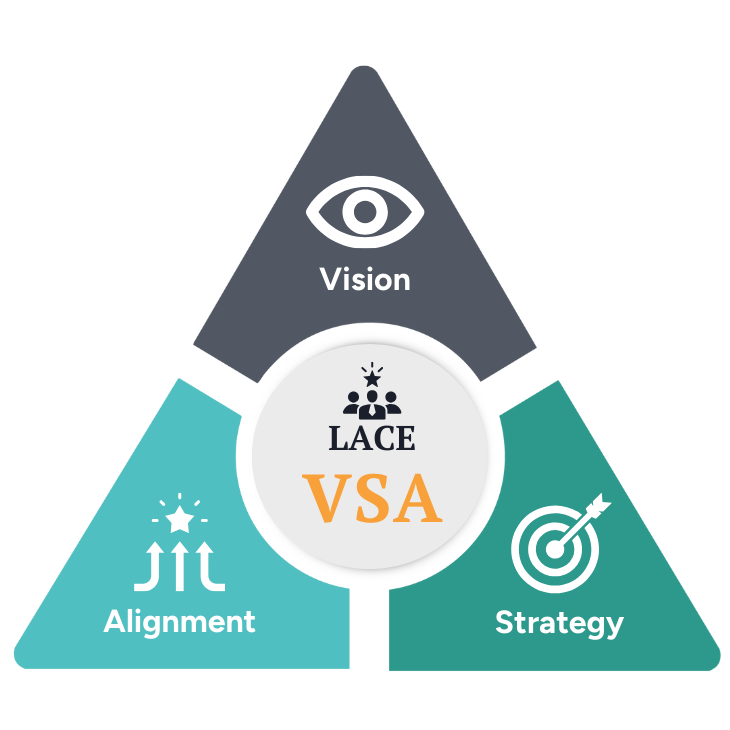
At Planet Ganges, we use the VSA (Vision, Strategy and Alignment) framework — a core component of the LACE transformation system — to rebuild alignment structurally. The starting point is a premise most firms skip: strategy and leadership cannot be fixed in isolation. Addressing one without the other produces temporary improvement at best.
We help you:
Synchronize the vision. Ensure every leader defines success the same way — not just in words, but in how they make daily decisions and allocate resources.
Map decision rights. Clarify who owns what, at what level, and with what accountability — so decisions stop traveling up to the CEO and start getting made where they should be.
Install a review rhythm. Implement a structured cadence for leadership reviews that catches alignment drift early, before it becomes a crisis or a departure.
Make hard calls with support. When misalignment has been tolerated for too long, we help leadership teams navigate the difficult pivots — people, priorities, and structure — that restore momentum.
Most leadership teams do not need more strategy. They need their existing strategy to actually move. That requires clarity on direction, owned decisions, and a review rhythm that holds people to it.
Conclusion
Leadership alignment is not a culture issue or a communication initiative. It is the operating infrastructure your strategy depends on. When it has structural cracks, execution degrades — regardless of how well the plan was constructed.
The good news: misalignment has identifiable causes and proven fixes. With the right framework and consistent accountability, the drag lifts. Execution becomes something the organization does systematically, not something the CEO drives manually.
If these patterns are present in your organization, the window to address them is now — not after the next planning cycle.
FAQs
What is the meaning of leadership misalignment?
Leadership misalignment is when the leaders of an organization operate with different understandings of priorities, goals, or what success looks like. On the surface everything appears functional — meetings happen, plans exist, numbers are reviewed. But decisions and actions diverge across functions because there is no shared anchor. Left unaddressed, it slows execution, creates internal friction, and quietly erodes the strategy from the inside out.
What are the common signs of leadership misalignment?
The most common signs are: the same decisions getting relitigated across meetings, individual functions hitting their targets while the organization misses its overall goals, every significant decision escalating to the CEO, and communication volume increasing while clarity decreases. Misalignment also shows up in middle manager attrition — when the leadership team is out of sync, friction accumulates in the layer below before it becomes visible at the top.
Does leadership misalignment impact business performance?
Yes — directly and measurably. Misaligned leadership slows time-to-market, dilutes capital across competing priorities, and creates the conditions for talent loss. Strong strategies fail not because the plan was wrong, but because the leadership team was not synchronized enough to execute it. The cost compounds quietly each quarter the misalignment goes unaddressed.
How do I improve leadership alignment in my organization?
Start with three structural fixes: get explicit agreement on the organization’s top priorities, define clear decision ownership at each leadership level, and install a review cadence that surfaces drift before it becomes a crisis. The factor most organizations overlook is that strategy alignment and leadership alignment must be worked on together — fixing one without the other produces short-term improvement that does not hold. Planet Ganges addresses both through the VSA and DR²P frameworks within the LACE system, making alignment a durable operating condition rather than a one-time offsite outcome.