

The real distinction is not premium versus standard hiring. It is whether the organisation is filling a role or protecting a strategic mandate.
| EXECUTIVE PREMISE At senior levels, a hiring decision becomes an enterprise decision because the leader will shape strategy, culture, governance and execution long after the appointment is made. |
|---|
The question is often framed too narrowly: should we use executive search or recruitment? That sounds like a choice between two sourcing channels, two fee structures or two timelines. For routine and clearly specified roles, that may be sufficient. For a board, founder, CEO or CHRO appointing a business-critical leader, it is not.
The more useful question is this: what degree of uncertainty must the organisation remove before it entrusts a leader with enterprise value, people, capital and reputation?
That is the strategic difference between executive search and recruitment. Recruitment is designed to fill defined positions efficiently from an accessible talent market. Executive search is designed to resolve a leadership problem when the mandate is consequential, the right candidates are difficult to access, and a technically qualified appointment may still fail because of context, culture or stakeholder complexity.
Executive Search vs Recruitment: The Difference That Matters

Both models can be valuable. The mistake is not choosing recruitment; it is using recruitment mechanics for a leadership decision that requires deeper diagnosis, market intelligence, assessment and transition support. Conversely, not every vacancy warrants a retained executive search. The method should follow the risk and complexity of the mandate.
| Decision lens | Executive search | Recruitment |
|---|---|---|
| Primary question | Who can deliver the mandate in this business context? | Who meets the defined role requirements and is available? |
| Typical use | Board, C-suite and business-critical leadership appointments | Defined roles with a visible and accessible candidate pool |
| Talent market | Actively maps and approaches passive, proven and hard-to-reach leaders | Primarily reaches applicants, databases, referrals and active candidates |
| Evaluation | Tests judgment, leadership maturity, contextual fit, stakeholder influence and risk | Screens experience, competence and fit against a role description |
| Governance | Creates a disciplined evidence base for a high-consequence decision | Runs an efficient hiring workflow against agreed specifications |
| Success horizon | Selection plus transition effectiveness over the first 90 to 180 days and beyond | Appointment, acceptance and onboarding hand-off |
Why the Choice Becomes Strategic at Senior Levels
A senior leader does not merely execute a job description. The leader interprets strategy, allocates attention and resources, establishes decision norms, shapes the leadership team and signals what the organisation will reward or tolerate. That is why the wrong appointment can damage far more than one function.
1. The mandate is larger than the role
A role description records responsibilities. A leadership mandate defines the business outcomes, difficult trade-offs and stakeholder expectations that the leader must navigate. A growth-stage CFO, for example, may need to institutionalise governance without suffocating entrepreneurial speed. A new CHRO may need to build leadership depth while retaining the cultural strengths of a founder-led business. A business head entering a transformation may need to restore execution credibility before pursuing growth.
When the mandate is not diagnosed first, organisations tend to hire the most impressive profile rather than the leader most suited to the next chapter.
2. Leadership fit is contextual, not generic
A leader can be highly successful in one environment and ineffective in another. Ownership structure, decision rights, governance maturity, market position, organisational pace and founder involvement all shape whether prior experience will transfer. Executive leadership assessment must therefore go beyond competence and career history to examine how a candidate thinks, decides, influences and adapts under the realities of the new organisation.
3. The hidden cost is strategic delay
Search fees are visible and easy to compare. The larger costs of a failed appointment are not: delayed transformation, missed market windows, leadership attrition, customer disruption, weakened governance and the loss of confidence among employees, investors or the board. At senior levels, the decision should not be optimised for the lowest acquisition cost. It should be designed to increase the probability of leadership effectiveness.
What Recruitment Is Designed to Do
Recruitment is the right model when the organisation understands the role, the success profile is stable, qualified candidates are reasonably visible, and the consequences of a longer learning curve are manageable. It creates reach, speed and process efficiency across hiring volumes and specialist requirements.
A strong recruitment process can define the position, attract or source candidates, screen for essential experience, coordinate interviews and close the hire efficiently. For many entry-level, middle-management, specialist and even some senior roles, this is exactly what the organisation needs.
Calling recruitment ‘transactional’ should not be used as a criticism. Transactional efficiency is valuable when the hiring problem is well understood. It becomes inadequate only when the organisation is facing a leadership question that has not yet been resolved.
What Executive Search Is Designed to Do
Executive search starts before candidate sourcing. It helps the organisation convert strategy into a leadership mandate, define the evidence required for success and map the market without being limited to who is actively looking for a job.
Context before credentials
The process begins by clarifying why the role exists now, what must change, what must be protected, and which outcomes the leader must deliver in the first year. This shifts the conversation from a list of responsibilities to the strategic conditions for success.
Market intelligence before applications
The strongest candidate may not be searching, may not hold the expected title, or may sit in an adjacent industry with more relevant transformation experience. Targeted market mapping creates a view of the leadership landscape, including competing talent pools, capability scarcity and realistic trade-offs.
Evidence before familiarity
Senior appointments are vulnerable to reputation bias, chemistry bias and logo bias. A rigorous executive hiring process tests the candidate against the mandate through structured interviews, business scenarios, psychometric or leadership assessments where appropriate, and referencing focused on the conditions under which the leader succeeds or struggles.
Transition before celebration
Appointment is not the same as effectiveness. A leader enters an established system of expectations, relationships and unwritten rules. Structured leadership transition coaching helps align the board, manager, peers and new leader around priorities, decision rhythm and early outcomes during the first 90 to 180 days.
Is Executive Search the Same as Headhunting?

No. Headhunting is a sourcing technique: identifying and approaching people who are not actively applying. Executive search is the wider advisory process that connects mandate definition, market mapping, candidate engagement, executive leadership assessment, selection and transition. Headhunting can produce names. Executive search must produce decision confidence.
Retained vs Contingency Recruitment: The Commercial Model Follows the Risk Model
The retained vs contingency recruitment debate is often reduced to when the fee is paid. The more important distinction is what the client is asking the firm to own.
A contingency recruiter is generally paid when a candidate is placed. This model suits roles where multiple recruiters can work the market, candidate availability is relatively high, and speed is a central measure of success.
A retained executive search firm is engaged exclusively to run a defined body of work. The investment pays for dedicated research, access to passive leaders, confidential engagement, structured evaluation and advisory support through a high-stakes decision. Fees and milestones vary by market, role and scope, but the commercial structure reflects commitment to the process rather than access to an existing database.
The board or CEO should therefore ask whether the mandate requires candidate supply or decision assurance. The answer should determine the model.
When to Use Executive Search: Seven Strategic Triggers
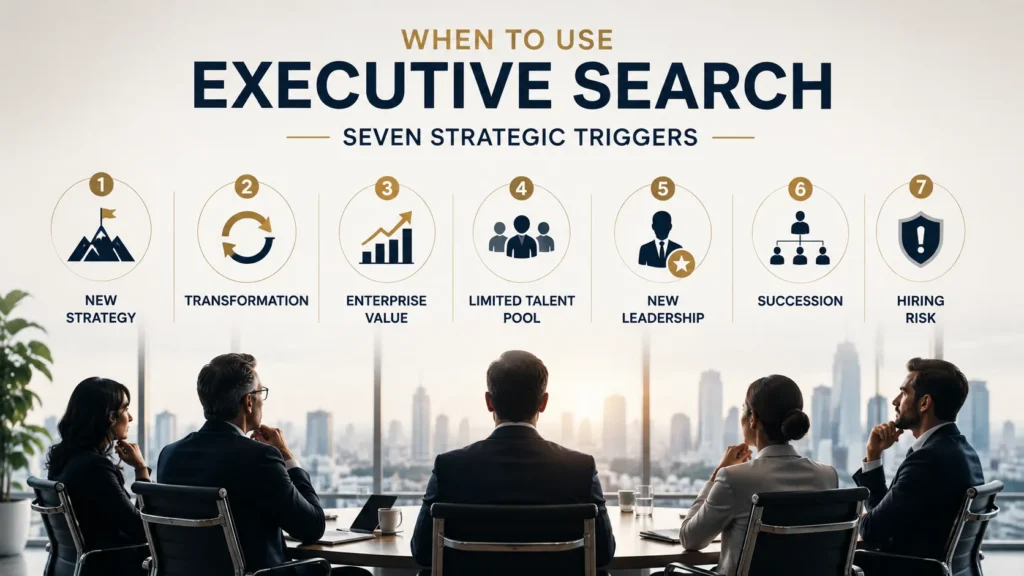
- The role will shape enterprise direction. The appointment owns strategy, capital allocation, transformation or material business risk.
- The organisation is at an inflection point. Growth, professionalisation, succession, geographic expansion, restructuring or a change in ownership has altered the leadership requirement.
- The mandate is new or difficult to define. The organisation needs advisory work to translate business ambition into leadership outcomes and capabilities.
- The best candidates are not visible. Relevant leaders are passive, scarce, confidentially placed or located outside obvious talent pools.
- Contextual fit will determine success. Founder dynamics, board expectations, culture, governance or stakeholder complexity make prior experience alone an unreliable predictor.
- The search must remain discreet. An incumbent replacement, succession discussion, investment event or market-sensitive move cannot be advertised openly.
- Failure would materially damage the business. A poor appointment would delay strategy, destabilise the leadership team or weaken enterprise value.
If these conditions are absent and the role is stable, well specified and supported by an accessible talent pool, recruitment is usually the more proportionate and efficient choice.
The Executive Hiring Process vs the Recruitment Process
A conventional recruitment process is typically linear: define the vacancy, source candidates, screen, interview, select and close. An executive hiring process is iterative because the organisation learns about both the market and its own requirements as the search progresses.
1. Clarify the leadership mandate. Translate strategy into first-year outcomes, decision accountabilities, stakeholder expectations and the leadership capabilities required.
2. Map the relevant market. Identify where suitable leadership exists, including non-obvious sectors, geographies and adjacent experiences.
3. Engage and evaluate leaders. Approach candidates discreetly and assess track record, judgment, learning agility, cultural alignment and risk against the mandate.
4. Build decision confidence. Present a focused shortlist with evidence, trade-offs and referencing that enables the board or leadership team to make a disciplined choice.
5. Protect the transition. Align expectations and support the new leader through the early months so that selection quality converts into performance.
A Decision Framework for Boards, CEOs and CHROs
Before deciding between executive search and recruitment, leadership teams should answer six questions:
- What business outcome makes this appointment necessary now?
- How much will this leader influence strategy, culture, governance and enterprise value?
- Is the success profile clear, or does the organisation need help defining the mandate?
- Are the best candidates likely to be active and visible, or passive and difficult to access?
- What evidence, beyond career history and interviews, is required to make the decision confidently?
- What must happen after appointment for the leader to become effective in this specific context?
| DECISION RULE Use recruitment when the position is defined and the talent market is accessible. Use executive search when the mandate is consequential and the organisation must reduce strategic uncertainty. |
|---|
The Planet Ganges Perspective: Search, Assessment and Transition as One System
Planet Ganges approaches senior leadership hiring as a business transformation and governance decision, not an isolated staffing exercise. Our SAT framework integrates Search, Assessment and Transition across the full leadership appointment cycle.
Search defines the mandate and identifies leaders who can deliver it. Assessment evaluates leadership judgment, capability, cultural alignment and derailment risk in context. Transition supports the leader and organisation through the first 90 to 180 days, when credibility, stakeholder alignment and operating rhythm are established.
This integrated approach matters because the quality of a search cannot be judged only by whether a candidate accepts an offer. The real test is whether the appointed leader earns trust, makes sound decisions and advances the organisation’s strategic agenda.
Executive Search vs Recruitment: The Final Test
The executive search vs recruitment decision should not be driven by prestige, habit or fee comparison. It should be driven by the nature of the leadership risk.
When the organisation needs to fill a clearly defined role from an accessible market, recruitment is efficient and appropriate. When it must appoint a leader who will shape direction, culture, governance and execution through a critical chapter, executive search provides the depth, evidence and discretion the decision requires.
The choice is ultimately simple: if you are filling a position, optimise the hiring process. If you are entrusting someone with a strategic mandate, architect the leadership decision.
Frequently Asked Questions
What is the difference between executive search and recruitment?
Recruitment fills defined roles from an accessible candidate market. Executive search addresses senior and business-critical leadership appointments through mandate definition, market mapping, proactive outreach, structured assessment and, where required, transition support.
Is executive search the same as executive recruitment?
The terms are sometimes used interchangeably, but executive search generally describes a retained, research-led and advisory process for high-impact leadership roles. Executive recruitment may also refer more broadly to recruiting senior candidates through conventional channels.
When should a company use an executive search firm?
Use an executive search firm when the role shapes enterprise direction, candidates are passive or scarce, confidentiality matters, contextual fit is critical, or the cost of leadership failure is materially greater than the search investment.
What does an executive hiring process include?
A robust executive hiring process includes leadership mandate definition, talent market mapping, discreet candidate engagement, executive leadership assessment, evidence-based shortlisting, referencing, selection and structured transition support.
What is retained vs contingency recruitment?
Retained search engages a firm exclusively to complete a defined search and advisory process, with fees paid against agreed milestones. Contingency recruitment generally pays the recruiter only when a placement is made and is best suited to roles with a more accessible candidate pool.
Does executive search work for founder-led and mid-market businesses?
Yes. Role criticality matters more than company size. A first CFO, CHRO, CEO successor or professional business head in a founder-led company can determine whether the organisation scales with control, preserves its strengths and reduces dependence on the founder.
How does leadership transition coaching improve search outcomes?
Transition coaching converts selection insight into early effectiveness. It aligns the leader and key stakeholders around priorities, relationships, decision rhythm and early wins during the first 90 to 180 days.