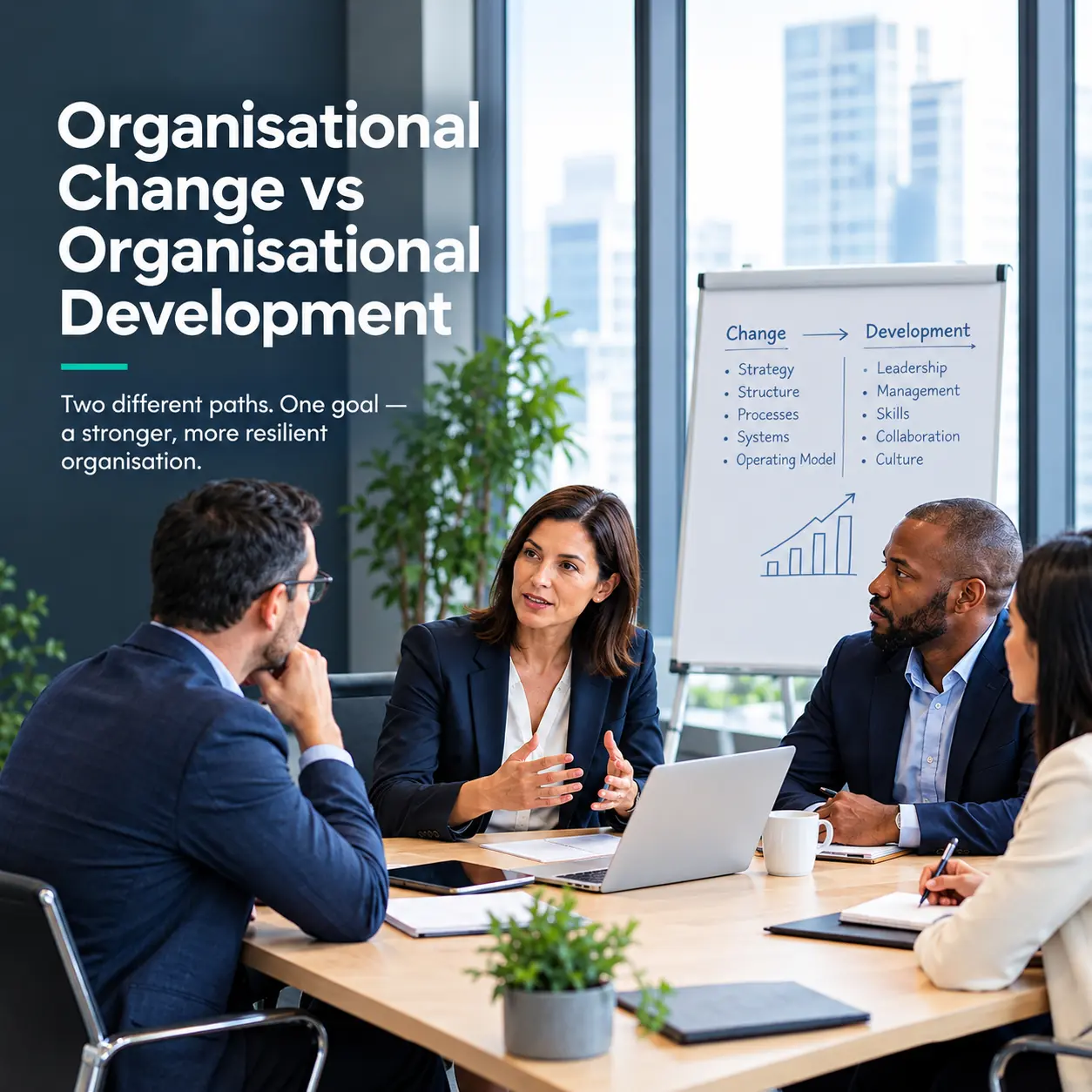

Organisational change and organisational development are often grouped under the human capital agenda, yet they address fundamentally different business needs. Change repositions an organisation toward a target operating state, whereas development builds the capabilities required to execute effectively as the business evolves.
For executive leaders, the real work is diagnosing which one the business actually needs: a structural and operational challenge, a capability constraint, or both. That diagnosis should directly govern the intervention, the resource allocation, and how success gets measured.
Organisational Change vs Development: Why the Distinction Matters
Organisational problems rarely arrive with a clear label. Slow decisions, weak execution, leadership dependency and poor collaboration can originate from very different causes.
Before choosing an intervention, executives should examine whether roles, reporting lines and accountabilities are clear, whether decisions are being made at the right level, whether leaders and teams have the skills the strategy requires, whether incentives and leadership practices reinforce the desired way of working, and whether the operating model actually supports the business direction.
The objective is to identify the constraint rather than respond to the most visible symptom.
What Organisational Change Actually Addresses

Organisational change is a strategic business intervention used when the current way of operating cannot deliver the organisation’s strategic goals.
Its purpose is to close the gap between what the strategy requires and what the organisation is currently able to deliver. This means changing the structure, operating model, decision-making, processes, and accountabilities needed to turn strategic priorities into measurable business outcomes.
Common triggers include a new corporate strategy or business model, mergers and acquisitions, rapid growth or market expansion, organisational restructuring, digital transformation, and shifts in customer expectations or competitive conditions. These changes often require the organisation to operate differently in order to achieve outcomes such as faster growth, greater efficiency, stronger customer outcomes, improved margins, or increased organisational agility.
Organisational consulting can help identify the root causes and design the right path forward.
What Organisational Development Actually Addresses
Organisational development focuses on building the capabilities the business needs to perform, grow, and adapt over time.
The core areas are leadership effectiveness, helping leaders make better decisions and lead change; management strength, building a pipeline of capable managers; and succession readiness, preparing people for critical leadership roles. They also include cross-functional collaboration, helping teams work effectively across functions; decision-making, improving the quality and speed of business decisions; organisational learning, building the capacity to adapt continuously; and strategic alignment, ensuring leadership behaviours support business priorities.
The focus depends on the organisation’s strategic needs.
Organisational Change vs Development: Key Differences
The operational distinction becomes clear when evaluating the decisions each function supports.
| Dimension | Organisational Change | Organisational Development |
| Core Business Question | What needs to operate differently? | What capabilities need to become stronger? |
| Main Focus | Structure, operating model, roles, processes, systems, and ways of working | Leadership, management, behaviours, collaboration, and organisational capability |
| Typical Trigger | Strategic or operational transition | Capability or performance requirement |
| Primary Horizon | A defined transition | Ongoing organisational effectiveness |
| Evidence of Progress | The new model is adopted and produces intended outcomes | Capability improves and contributes to sustained performance |
Take an enterprise where decisions consistently stall. An organisation hampered by excessive governance layers requires a redesign of decision rights, which is change. Another organisation with an optimal governance structure has leaders who lack the confidence or commercial skill to execute independently, which is development.
While the operational symptom is identical, the executive intervention must not be.
Where Leaders Commonly Misdiagnose Organisational Problems
Restructuring a capability problem
Restructuring can create clarity when the organisation’s structure is directly preventing effective execution. But restructuring does not solve problems when the real issues come from other areas.
An organisation repeatedly changes reporting lines without addressing outdated incentives, leadership behaviours, or decision-making habits. Functional leaders keep protecting their own teams, senior executives stay involved in day-to-day operations, and employees keep escalating routine decisions.
In such cases, the organisational chart has changed, but the main performance problem remains. Before starting another restructuring exercise, executives should first determine whether the problem is caused by the organisational structure or by the organisation’s ability to work effectively within that structure.
Developing around a structural problem
The opposite mistake can be just as harmful. An organisation invests heavily in executive coaching and leadership development while leaving unclear responsibilities, overlapping roles, and weak governance unresolved.
For example, regional and corporate teams compete for control over the same customer account decisions. Even if leadership skills improve, executives will continue to face conflicts created by the organisation’s structure.
Structural clarity should come first. Once roles, decision-making authority, and governance boundaries are clearly defined, leadership development can help executives and teams work effectively within that structure.
When Organisations Need Both Change and Development

Organisations need both change and development when the business requires changes to its operating model and the leadership capabilities to make those changes work. This is common when the strategy requires a new way of operating, when roles, structures or decision rights need to change, when leaders need new skills and behaviours, or when the organisation must build the capability to sustain the change.
Change creates the right organisational environment. Development builds the capability to perform within it.
Diagnosing Whether Your Organisation Needs Change or Development
A strong executive assessment starts with five key questions.
Has the strategy moved faster than the organisation? When a business enters new markets, changes its business model, or adopts a new strategy, check whether its current operating model can support the change. A strategy that requires fast decisions will struggle if too many approval levels slow things down.
Where is execution breaking down? Identify where work is getting delayed, or responsibilities are unclear. Decision-making processes, handovers between teams, governance meetings, and resource allocation often reveal problems that are not visible in the organisational structure.
What capabilities are needed for the next stage? Identify the skills and capabilities needed to deliver the future strategy and compare them with what the organisation currently has. This should include leadership, technical, commercial, and functional capabilities.
Are the problems structural, behavioural, or both? Avoid assuming that every performance problem has one cause. Changes in structure affect roles, authority, and incentives, while leadership behaviour determines how effectively those changes work in practice.
What needs to remain after the transformation? Every major transformation should create capabilities that continue after the transformation team and external consultants leave. Identify the behaviours, leadership practices, and management systems that need to become part of everyday operations.
What to Measure After Organisational Change or Development
Measurement frameworks should track the business results the intervention is meant to improve.
For organisational change, measure improvements in operational speed, productivity, cost efficiency, customer outcomes, process adoption, and value delivered against the target operating model. For organisational development, measure improvements in organisational capability, such as leadership strength, succession readiness, management effectiveness, cross-functional collaboration, decision quality, and the ability to adapt to change.
Employee participation and course completion rates are activity measures, not proof of business impact. The key question is simple: can the organisation now execute its strategy more effectively than before?
The Strategic Takeaway
Organisational change and organisational development create the most value when they are treated as strategic business priorities, not separate HR initiatives.
Executives should first identify what is limiting performance and then choose the right response: a stronger organisational structure, better leadership capabilities, or a combination of both.
When the current operating model no longer supports the strategy, organisational change is needed. When the structure works but leadership capabilities are not strong enough, organisational development should be the priority. When both problems exist, the two approaches should be integrated.
The right transformation starts with identifying the real business constraint, not simply changing structures or adding training.
Planet Ganges helps organisations diagnose and address these challenges, improving execution, leadership capability, and performance. Get in touch for a confidential discussion.
FAQs
What is the difference between organisational change and organisational development?
Organisational change repositions a business toward a new operating state, addressing structure, decision-making, and processes. Organisational development builds the leadership and management capability needed to execute effectively, regardless of the operating model.
When should a business choose organisational change over organisational development?
When the current operating model cannot deliver the strategy, such as after a merger, a new corporate strategy, or rapid market expansion, the priority is organisational change rather than development.
Can organisational development fix a structural problem?
No. If roles, decision rights, or governance boundaries are unclear, leadership development alone will not resolve the conflicts that structure creates. Structural clarity has to come first.
Can restructuring fix a capability problem?
No. Restructuring changes the organisational chart, but if the real issue is outdated incentives, leadership behaviours, or decision-making habits, the performance problem remains even after the structure changes.
How do executives know if they need both change and development?
Both are usually needed when the business must change its operating model and also build the leadership capability to make that new model work, such as during a major strategic shift or transformation.
What should be measured after an organisational change initiative?
Operational speed, productivity, cost efficiency, customer outcomes, process adoption, and value delivered against the target operating model.
What should be measured after an organisational development initiative?
Leadership strength, succession readiness, management effectiveness, cross-functional collaboration, decision quality, and the organisation’s ability to adapt to change.