
Most boards apply forensic rigour to financial ratios, capital commitments and audit findings. The CEO performance evaluation is often the one exception, treated as an annual formality instead of a governance instrument. That gap leaves the board carrying a risk it has never actually measured: leadership risk.
Why CEO performance evaluation is a governance duty, not a compliance task

The annual review is one of the few moments a board steps back from operating numbers to judge the quality of leadership producing them.
A strong year can come from a favourable market, organisational momentum, or a leadership team that carried more weight than the CEO did. A weak year can follow tough calls that protected the business through a difficult cycle. Neither should be judged on the number alone.
A rigorous CEO performance evaluation asks three things: what the CEO delivered, how it was delivered, and whether the organisation is more capable as a result. Most evaluations stop at the first question. The third is what separates a real evaluation from a formality.
What the law requires
CEO performance evaluation is a statutory requirement in India wherever the CEO also sits on the board. Sections 178(2) and 134(3)(p) of the Companies Act require the Nomination and Remuneration Committee to set a formal evaluation framework and disclose its methodology. SEBI LODR Regulation 17(10) and Schedule IV require independent directors to formally assess non-independent directors and the chairperson.
The law sets the obligation. It says nothing about the quality of judgement behind it. Getting that judgement right, beyond the statutory minimum, is where independent governance advisory earns its place, giving directors evidence they cannot generate on their own.
The four things a CEO performance evaluation should measure
| Dimension | What to measure | Key question |
| Financial and operating discipline | Revenue, EBITDA and cash flow against the approved plan; ROIC and capital allocation discipline; margin stability; customer retention and market share | Did the CEO honour the commitment made to the board, not just beat last year’s number? |
| Strategic choices and risk oversight | Progress on core strategic initiatives; discipline in capital and talent allocation; management of enterprise risk and regulatory exposure | Did the CEO turn agreed strategy into disciplined decisions? |
| Leadership behaviour and culture | Handling of bad news; psychological safety across the C-suite; retention and growth of mission-critical leaders | Is the CEO building a resilient organisation or a personal power base? |
| Succession readiness | Bench strength; successor readiness; concentration of capability in one person | Could the organisation perform if this CEO left tomorrow? |
Growth alone tells you what changed. Performance against plan tells you whether the CEO honoured a commitment to the board. A CEO who beats the plan by cutting long-term investment, starving talent or taking on unapproved risk is producing a result the board should be uneasy about, not applauding.
On culture specifically: two CEOs can post identical quarterly numbers while building very different organisations. One builds transparency and develops successors. The other centralises control and discourages dissent. This is where structured leadership assessment consulting earns its place, replacing director guesswork with evidence.
On succession, the board should be able to answer these honestly:
● Is there a credible successor ready if the CEO left tomorrow?
● Are enough tier-two executives being developed for bigger roles?
● Is the CEO building future leaders, or accumulating power?
● Is any critical capability or relationship locked inside one person?
● Is the leadership bench actually stronger than it was a year ago?
An indispensable CEO is not evidence of strength. It is a governance vulnerability. Succession planning is not a contingency drill for the day a CEO resigns. It is one of the clearest signals of long-term value creation.
How to structure the evaluation through the year
Most CEO evaluations are built backwards, reconstructed at year-end from a stack of presentations and a handful of memorable events. This leaves them vulnerable to recency bias, and to whoever tells the best story in the room, which is usually the CEO.
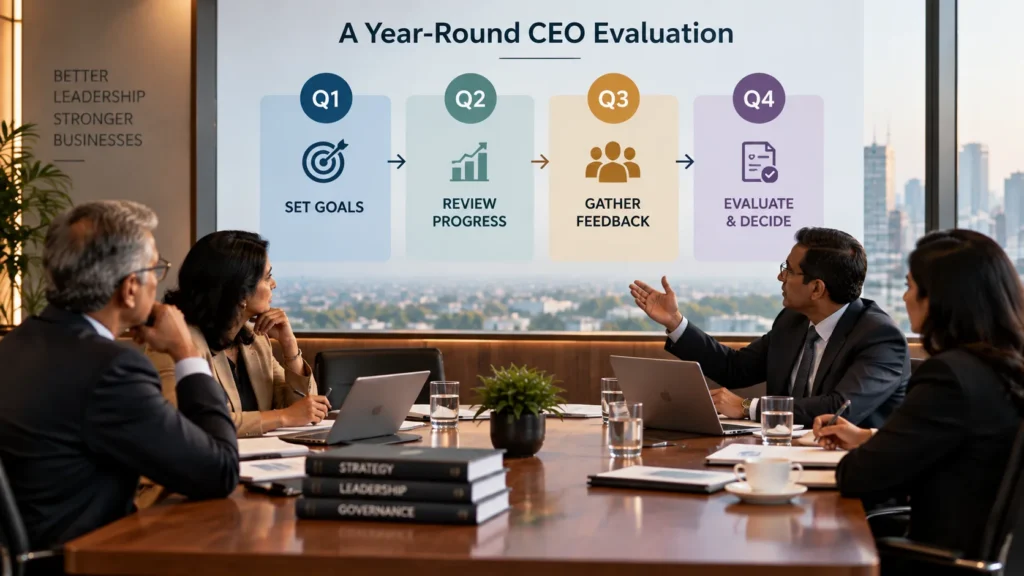
A stronger process runs on a fixed calendar. In the first quarter, the board chair and the NRC agree balanced quantitative and qualitative targets tied to the multi-year plan. By the second quarter, an informal review checks strategic direction and flags emerging problems before they compound. The real evidence gathering happens in the fourth quarter, through a structured self-assessment from the CEO, 360-degree feedback from key executives, and a review of regulatory and audit compliance. At year-end, independent directors meet without the CEO present to weigh what they have heard, and the board chair delivers that feedback privately.
Turning the evaluation into a decision
An evaluation that ends in a score and nothing else has failed. The board and the NRC have four real levers, and using the wrong one is its own governance failure.
If the gap is capability in a specific area, the answer is targeted coaching or leadership development consulting, with a clear review timeline. If the organisation has simply outgrown what one person can run, the answer is restructuring the C-suite around the CEO, not around a scorecard. If performance is strong but incentives are not aligned with what actually mattered, the answer is adjusting variable compensation. If the gap is in strategic alignment or leadership behaviour, and it has been consistent rather than a one-off, the honest answer is succession: engaging a specialised executive search process to manage the transition deliberately.
Evaluating a founder or promoter CEO
In founder-led and family-owned enterprises in India, the CEO may also be the majority shareholder and the board chair. The board is evaluating someone who holds real influence over the people evaluating them.
Two things make this workable. Set objective, written criteria at the start of the year, before performance is known, so any critical feedback cannot later be read as personal. Bring in an independent external advisor to facilitate the process. This distance keeps feedback focused on enterprise performance rather than letting it turn into a personal conversation.
What the board owes the CEO
Before holding the CEO fully accountable for a missed target, the board should ask how much of that outcome it created. Unclear priorities, decisions delayed at board level, resources withheld, or a strategy that changed direction twice in one year: none of that can be separated from how the CEO performed against it.
The strongest boards use the evaluation for two things: deciding what the CEO needs to do differently, and deciding what the board needs to do differently to make that possible.
Conclusion
A CEO performance evaluation is not really asking whether the CEO had a good year. It is asking whether the CEO is building an organisation that can perform without depending entirely on them. That is the standard that makes the exercise useful to the board, credible to shareholders, and relevant to where the business is headed.
If your board needs an independent view of CEO performance, leadership capability or succession readiness, Planet Ganges can support that conversation in confidence. Get in touch.
FAQs
What is a CEO performance evaluation?
A CEO performance evaluation is a structured, board-led review of the CEO’s results, decisions and leadership behaviour, measured against agreed targets rather than the CEO’s own account of the year.
Who conducts the CEO performance evaluation?
The board conducts it through the Nomination and Remuneration Committee and the independent directors, with final feedback delivered by the board chair or the lead independent director.
Is CEO performance evaluation mandatory in India?
Yes. The Companies Act, 2013 and SEBI LODR Regulation 17(10) require formal evaluation of all directors, including the CEO where the CEO sits on the board, with disclosure in the Board’s Report.
What happens if a CEO performance evaluation result is poor?
The board has four options: targeted coaching, restructuring the C-suite, adjusting compensation, or initiating a structured succession process. Doing nothing is not one of them.
How often should a board run a CEO performance evaluation?
Formally, once a year. In practice, the strongest boards treat it as a continuous cycle, with targets set early, a mid-year check, and evidence gathered throughout rather than assembled at the last minute.
Who should evaluate a founder or promoter CEO?
The same board process applies, but it works better with an independent external advisor facilitating it, since the CEO may also be the majority shareholder or board chair.