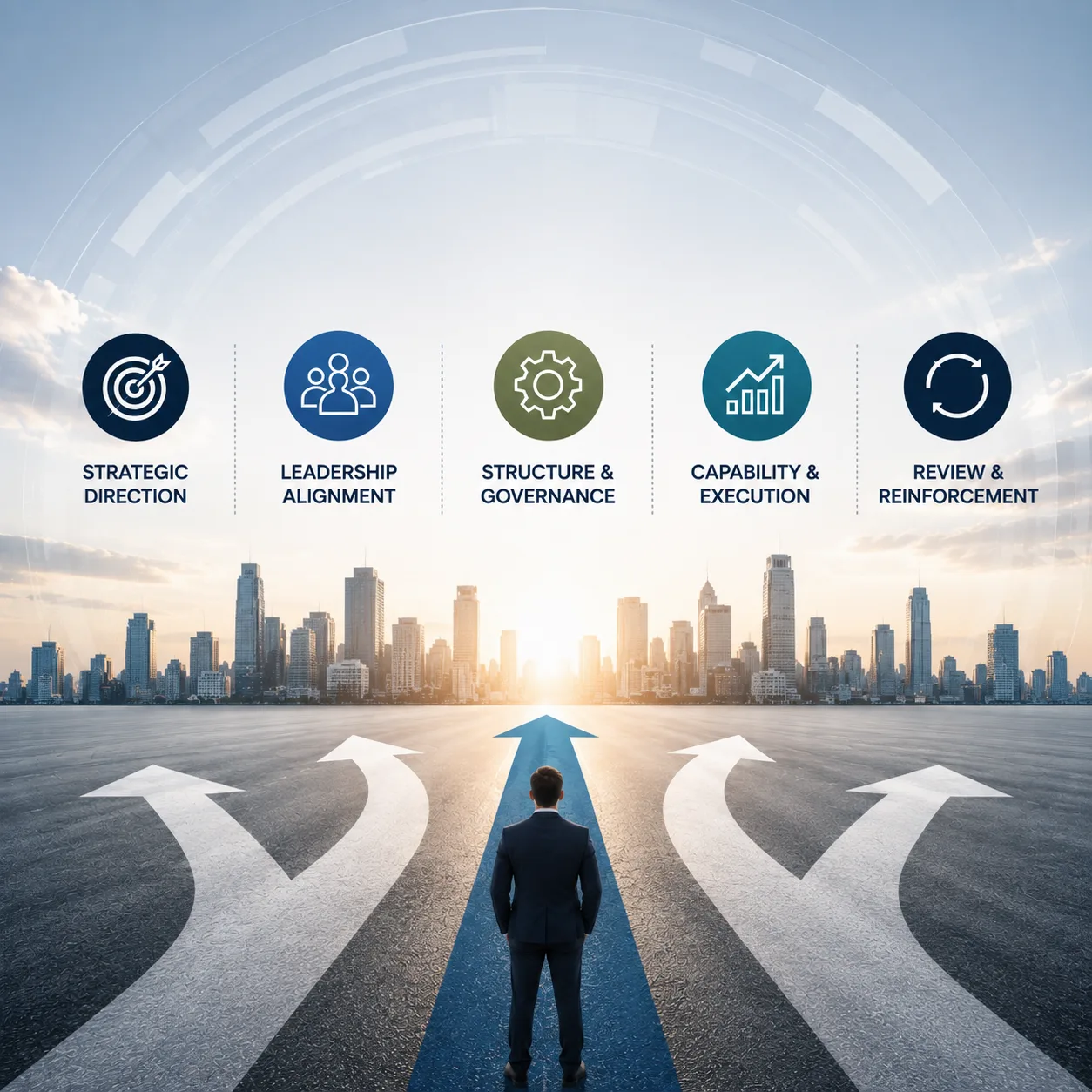

Businesses are under growing pressure to transform faster than ever before. AI adoption, digital operating models, leadership restructuring, and rapid scaling have shifted the digital transformation from a long-term strategic goal to an immediate business priority.
Yet despite rising investment, most transformation programmes still fail, not because the strategy is wrong, but because execution breaks down. Leadership misalignment, weak governance, cultural resistance, and poor operational readiness continue to derail even well-funded initiatives.
This is where business transformation consultants play a critical role in 2026.

Modern transformation consultants are no longer limited to process improvement or system implementation. They help organisations diagnose operational gaps, design transformation roadmaps, align leadership, govern execution, and ensure change delivers measurable business outcomes.
This guide explains what a business transformation consultant actually does, how the role has evolved due to AI, when businesses should hire one, and what transformation consulting costs in India today.
What Is a Business Transformation Consultant and Their Role?
A business transformation consultant is a strategic execution partner who helps organisations fundamentally change how they operate, compete, and deliver value. They are not project managers, not technology vendors, and not management consultants who hand over a report and leave. They own the full arc of change, from the first diagnostic through to sustained results on the ground.
The work of a business transformation consultant spans three distinct phases: diagnosing where the organisation is, designing where it needs to go, and governing execution until it gets there. Each phase is equally important. Most transformation failures happen when one of the three is underweighted.
Phase 1: Business Diagnosis & Organisational Assessment
Every engagement begins with a rigorous and honest assessment of where the organisation actually stands, not where leadership believes it stands. This means examining leadership alignment, decision-making patterns, process efficiency, execution gaps, technology infrastructure, and the cultural blockers that slow or prevent change.
In 2026, this diagnostic phase invariably includes an AI readiness assessment: evaluating whether the organisation has the data architecture, governance frameworks, talent mix, and cultural mindset to deploy and benefit from AI at scale. Many organisations discover at this stage that their AI ambitions are significantly ahead of their operational reality. The pilot worked. The organisation is not yet ready to scale it.
Phase 2: Transformation Strategy & Roadmap Development
With a clear diagnosis, the consultant develops an organisational transformation roadmap, a prioritised, sequenced plan identifying what needs to change, how those changes will be governed, and how progress will be measured.
Critically, this is not a strategy document. It is an execution plan: clear milestones, clear ownership, and accountability mechanisms built in from day one. For many organisations navigating the founder-to-professional management transition, this roadmap must also address the informal systems that actually drive behaviour: what gets rewarded, what leadership models are publicly acknowledged, and which non-negotiables the organisation is willing to enforce. A transformation that ignores informal systems consistently fails.
Phase 3: Execution Oversight & Change Enablement
Strategy without execution is the single biggest reason transformation programmes fail. Modern transformation consultants do not hand over a document and depart. They embed in the execution process, running governance rhythms, tracking initiative progress, surfacing blockers before they become derailments, and course-correcting as conditions evolve.
Change enablement is equally critical. Transformations fail when the people who must change their behaviour either do not understand why change is necessary or lack the tools to do so. Consultants design communication strategies, capability-building programmes, and leadership engagement frameworks that make behavioural adoption achievable across the organisation.
Core Deliverables
While every engagement differs, most transformation consulting programmes produce a common set of strategic and operational deliverables.
• Transformation roadmaps with prioritised initiatives, sequenced timelines, and investment requirements
• Operational audits identifying inefficiency, structural risk, and execution bottlenecks
• AI readiness assessments evaluating data maturity, talent capability, technology infrastructure, and governance frameworks
• Digital adoption strategies that sequence technology implementation with workforce capability building
• Execution governance frameworks for tracking progress and maintaining board-level visibility
• Organisational change plans covering leadership alignment, communication, and capability development
How Business Transformation Consulting Services Changed Between 2020 and 2026

The transformation consultant of 2026 is a fundamentally different practitioner from their 2019 counterpart. Three forces reshaped the role: the acceleration of AI, the compression of competitive cycles, and the rising complexity of organisational change in India’s post-pandemic business environment.
Before 2020
Before 2020, transformation consulting in India was primarily associated with cost restructuring, ERP implementations, post-merger integration, and process redesign. Engagements were multi-year, heavily staffed, and measured by cost savings or efficiency ratios.
Change management was treated as a peripheral workstream, not a core competency. The transformation consultant of 2019 was, at their core, a process engineer with strong project management capability. The question they answered: how do we do what we do, better and more cheaply?
In 2026
That question has been replaced by something more complex: how do we fundamentally change what we do, and how we do it, faster than our competitors, while managing the organisational disruption that change creates?
For many business leaders, this shift is particularly acute. India’s most dynamic sectors, financial services, manufacturing, consumer, healthcare, and technology, are all experiencing simultaneous pressure from AI disruption, talent market evolution, regulatory change, and competitive intensity from domestic and global players. Transformation is no longer a periodic event triggered by a crisis. It is a continuous organisational capability.
How AI Is Reshaping Business Transformation
Three shifts define AI’s impact on transformation practice.
- First, AI is accelerating the pace at which organisations must transform; competitive advantages that once lasted a decade now erode in two to three years.
- Second, AI is expanding the scope of transformation beyond functional optimisation into business model reinvention: organisations are rethinking not just how they operate but what they do and who they serve.
- Third, AI is making transformation more continuous rather than through periodic large-scale programmes, leading Indian organisations to build ongoing transformation capabilities that identify, evaluate, and implement improvements continuously.
Bain & Company’s research consistently finds that organisations with dedicated transformation leadership are significantly more likely to achieve AI ROI than those managing AI adoption through existing business units alone.
Why Most Business Transformations Still Fail in 2026
Despite growing investment and a maturing consulting ecosystem, the failure rate for transformation programmes remains stubbornly high. McKinsey research consistently estimates that approximately 70% of transformation programmes do not achieve their stated objectives. For Indian business leaders, understanding exactly why this happens is a prerequisite for doing it differently.
The Real Reasons Transformation Initiatives Fail
The most common failure modes are not technical. They are organisational and human:
- Poor leadership alignment
- Insufficient change management investment
- Unrealistic timelines
- Under-investment in capability building
- The failure to sustain execution momentum through the difficult middle phase of any major change programme
Two failure modes are particularly prominent. The first is founder dependency ,where transformation depends on the founder’s personal authority rather than building institutional systems that function without them.
The second is the strategy-execution gap, where leadership is aligned on direction, but the organisation lacks execution infrastructure to move. There are a few subtle signs that your leadership is not aligned, for example, leaders are discussing the same issues in every meeting. Look for the signs early to fix the gaps.
How Business Transformation Consulting Services Reduce Failure Risk

A top business transformation consultant reduces failure risk through three mechanisms.
- They bring pattern recognition from comparable programmes, helping organisations avoid costly mistakes they would otherwise have to learn from firsthand.
- They provide an independent assessment that internal teams, whose careers are tied to existing initiatives, cannot credibly offer.
- And they provide the execution discipline and governance that keeps programmes on track when organisational attention inevitably shifts toward operational priorities.
When Should You Hire a Business Transformation Consultant?
Hire a business transformation consultant when the gap between your strategic ambitions and your organisation’s current execution capability is too large to close with internal resources alone, and when the cost of delay exceeds the cost of external expertise.
Signs You Need Business Transformation Consulting Services
- Growth Has Stalled
If revenue growth has plateaued despite adequate market demand, the constraint is almost always internal: an operating model that cannot scale, processes that create friction, or a structure that slows decision-making. This is especially common in Indian businesses crossing the ₹200-500 crore revenue threshold, where systems that drove early growth begin actively blocking the next phase.
- AI Strategy Lacks Direction
If your AI strategy consists of pilots that never scale, vendors selected without a clear use case framework, or technology investments not generating measurable returns, transformation consulting can provide the structure needed to close that gap.
- Internal Transformation Efforts Keep Losing Momentum
If you have launched transformation programmes before and seen them stall, not because the strategy was wrong but because execution lost focus, that is a governance and leadership problem, not a strategy problem. External transformation support provides the accountability and structure needed to sustain momentum.
- Organisational Change Is Creating Complexity
Mergers, acquisitions, rapid headcount scaling, leadership transitions, or significant market disruption all create organisational complexity that internal teams struggle to manage while simultaneously running the business. Transformation consultants provide a structured framework for navigating that complexity without losing operational continuity.
When You Should NOT Hire a Consultant
If your organisation has not yet defined clear strategic objectives, no external consultant can help you transform toward a destination you have not chosen. Similarly, if executive alignment is absent, if the leadership team is not genuinely committed to transformation, no consultant can create that commitment from outside.
The investment will produce reports, not results. Transformation consulting also demands meaningful organisational investment beyond the consulting fees: leadership time, execution resources, and the institutional willingness to make uncomfortable decisions. If those conditions are not in place, the engagement will not succeed.
How to Prepare Before Hiring a Consultant
Organisations that get the most from a digital transformation consultant enter engagements with clear objectives, genuine executive sponsorship, and an honest understanding of the change involved. Before hiring, define what success looks like in measurable terms. Identify the executive sponsor who owns the outcome as an active participant, not a figurehead. And honestly assess whether your organisation has the appetite for the level of disruption that real transformation requires.
Cost of Hiring a Business Transformation Consultant in India in 2026
Transformation consulting costs in India vary significantly by firm tier, engagement scope, and team seniority.
Organisations building internal transformation capability typically hire Chief Transformation Officers or VP-level Heads of Transformation. In 2026, total compensation for senior internal transformation leaders at large Indian enterprises ranges from ₹60 lakh to ₹1.5 crore annually, depending on company size, sector, and city.
Director-level transformation programme managers typically earn ₹30 lakh to ₹60 lakh. At global MNCs with significant operations in India, rupee-equivalent packages for C-suite transformation roles can reach ₹2 crore or more.
What to Look for When Hiring a Business Transformation Consultant

- Industry Expertise vs Functional Expertis
The best digital transformation consultants bring both. Industry expertise matters because transformation challenges are shaped by sector-specific dynamics, regulatory environments, competitive structures, customer expectations, and technology adoption patterns, all of which vary significantly across Indian industries.
Functional expertise in areas like AI strategy, digital operations, or organisational design matters because transformation requires deep competence in the specific domains being changed.
For talent-related transformation dimensions, talent transformation consulting is a distinct and critical specialisation, and one that is frequently under-resourced in Indian transformation programmes.
- AI Literacy Is Non-Negotiable in 2026
In 2026, AI literacy is a baseline requirement, not a differentiator, for any transformation consultant working with Indian enterprise organisations. An AI business transformation consultant who cannot credibly assess your AI readiness, evaluate AI vendor proposals, design AI governance frameworks appropriate for India’s regulatory environment, or identify high-value AI use cases in your specific operational context is not equipped to lead modern transformation programmes.
Questions to Ask Before Hiring a Consultant
• What transformation programmes have you led, and what were the measurable outcomes?
• How do you specifically approach the founder-to-professional management transition?
• How do you assess AI readiness?
• How do you structure execution governance to maintain momentum across a multi-quarter programme?
• What does the organisation look like at the end of your engagement? Is internal capability stronger?
• Who specifically will be working with us day-to-day, and what is their relevant experience?
How Planet Ganges Helps Businesses Navigate Transformation
Planet Ganges is a modern business transformation consulting partner that works with founders, CXOs, and enterprise leaders to bridge the gap between transformation ambition and operational execution, across digital operating models, organisational change, and leadership capability.
Our engagements are built around measurable outcomes: operational agility, execution alignment, and scalable growth. Whether you are a 100-crore business or a 1,000-crore enterprise redesigning your operating model, we bring the structured leadership your programme requires.
Conclusion
Business transformation consulting has evolved into a strategic execution function focused on helping organisations turn change initiatives into measurable business outcomes.
In 2026, transformation is no longer a one-time project. AI disruption, competitive pressure, and evolving operating models are forcing businesses to adapt continuously. The organisations that succeed will not be the ones with the biggest transformation plans, but the ones with the execution capability to make those plans work.
That is the real role of a business transformation consultant: bridging the gap between strategy and execution, reducing transformation risk, aligning leadership, and helping organisations build the operational discipline required for long-term growth.
Frequently Asked Questions
What does a business transformation consultant do?
Diagnoses organisational gaps, designs transformation roadmaps, oversees execution, and manages change across strategy, operations, people, and technology.
How is a business transformation consultant different from a management consultant?
Management consultants deliver recommendations. Transformation consultants own execution and are accountable for whether change actually happens.
When should an organziation hire a business transformation consultant?
When growth stalls, the AI strategy is not scaling, internal transformation keeps losing momentum, or organisational complexity outpaces internal capability.
How much does business transformation consulting cost in India?
₹75,000 to ₹50 lakh per project for mid-market firms; ₹3-5 lakh per day for global tier; ₹1.5-4 lakh per month for fractional engagement models.
Is an AI business transformation consultant the same as a business transformation consultant?
No. An AI transformation consultant focuses specifically on helping organisations adopt, govern, and scale AI initiatives. A business transformation consultant takes a broader role, aligning strategy, operations, leadership, people, technology, and execution across the entire organisation. In 2026, many business transformation consultants will also bring AI transformation expertise because AI is now central to most enterprise transformation programmes.